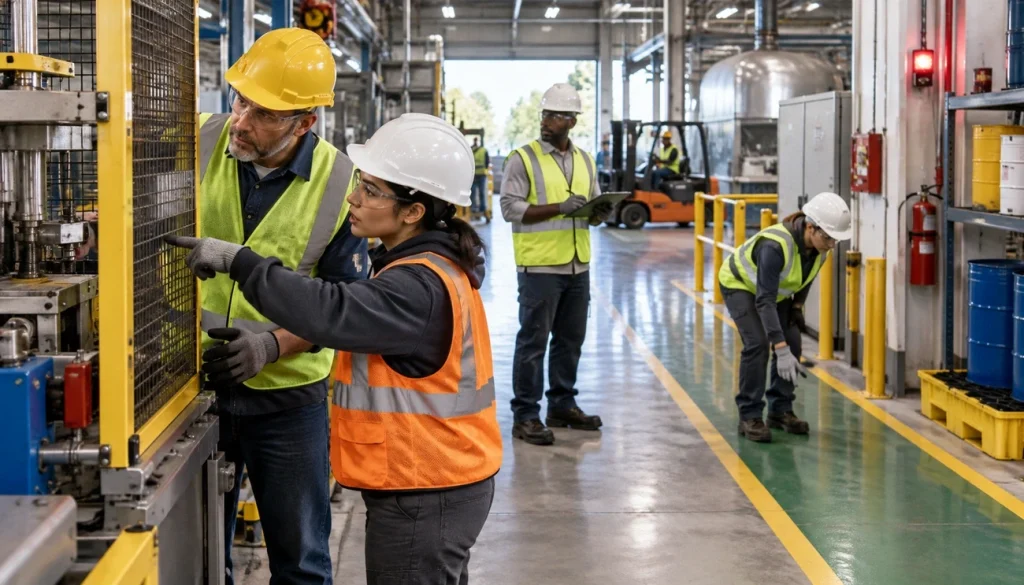

A machine operator does not notice hearing loss the way they notice a cut or a burn. It shows up as asking someone to repeat themselves, turning the truck radio up another notch, missing a warning shout on the floor. Noise-induced hearing loss in the workplace builds quietly over years, which is exactly why so many programs treat it as a lower priority than injuries that show up in an incident report the same day they happen.

That quiet accumulation is also what makes it expensive. A worker who can no longer hear a backup alarm, a coworker’s warning, or a safety briefing clearly is a productivity and safety problem long before it becomes a workers’ compensation claim. The numbers behind that quiet accumulation are worth seeing all at once.

Why it matters

  • About 22 million U.S. workers are exposed to hazardous noise on the job every year, according to NIOSH.
  • Occupational hearing loss is the most common work injury in the United States, and a peer-reviewed federal study found most cases are never compensated, which means workers’ comp data understates the real number.
  • A NIOSH-funded 2009-2013 claims analysis put the actual annual cost of occupational hearing loss claims at roughly $60 million, a more current and better-documented figure than the older estimate still widely quoted online.
  • OSHA requires a full hearing conservation program as soon as worker noise exposure reaches an 8-hour average of 85 decibels, a lower threshold than most people associate with hearing damage.

Explore Hearing Protection

Hearing Loss Is Permanent, Which Sets It Apart From Most Workplace Injuries

Noise-induced hearing loss comes from damage to the hair cells inside the inner ear, and those cells do not regenerate. A sprain heals with rest, and a cut closes on its own within days. Hearing damaged by years of noise exposure never recovers that way, which is part of why prevention carries more weight here than in almost any other category of workplace injury. No equivalent of physical therapy restores what was lost.

OSHA Hearing Conservation Requirements Start at 85 Decibels

OSHA’s occupational noise standard, 29 CFR 1910.95, requires a hearing conservation program whenever employee noise exposure reaches an 8-hour time-weighted average of 85 decibels, the action level. Identifying workplace noise hazards at that level requires actual measurement: a full-shift average built from a blend of loud and quiet periods, so a stamping line that peaks at 95 decibels for part of a shift and drops to 70 for the rest can still average out above the threshold.

Once a worker crosses that line, the standard requires five things: noise monitoring, audiometric testing at no cost to the worker, available hearing protection, annual training, and recordkeeping that holds up decades later if a claim is filed. Skipping any one of the five leaves a real gap, even if hearing protection itself is handed out consistently.

Why Occupational Hearing Loss Stays So Underreported

Hearing loss develops gradually, often over a working lifetime, so a worker rarely connects a specific shift or year to the damage. By the time a hearing loss claim is filed, the exposure that caused it may have happened at a previous employer, or it may have progressed so slowly that the worker never flagged it as an injury. That gap between exposure and recognition is a large part of why the true burden of occupational hearing loss is hard to measure accurately, and why the baseline audiogram OSHA requires within six months of a worker’s first exposure matters as much as the annual one that follows.

Industrial Hearing Protection Has to Match the Job

A foam earplug rated for a 95-decibel stamping floor is not the right choice for a forklift operator who needs to hear a backup alarm, or a crew that has to communicate constantly over a radio. Over-protecting a worker who needs situational awareness creates its own safety problem, even though it looks like the cautious choice on paper. Matching protection to the actual task, rather than the loudest number on a noise survey, is what keeps a hearing conservation program from working against the rest of the safety program.

The Productivity Cost Shows Up Long Before the Claim Does

A worker who has to ask a coworker to repeat an instruction, or who misreads a hand signal because they did not hear the shout that came with it, is already living out a hearing loss statistic in progress. That is a near miss, a rework order, or a quality defect happening in real time. Crews that rely on verbal coordination gradually lose that coordination as hearing damage accumulates, long before anyone files a claim or fails a hearing test.

The same dynamic shows up in retention. Workers who feel less safe or less able to do their job well tend to disengage or leave, and replacing an experienced machine operator costs far more than the hearing protection that could have kept them fully capable in the role. None of this shows up on an OSHA 300 log. It shows up in turnover reports and quality metrics that rarely get connected back to a noise problem on the floor.

How Arbill Supports Hearing Conservation Programs

Arbill’s guide to choosing hearing protection breaks down how to match protection level to task, and the guide to avoiding overprotection covers the situational-awareness side of that same decision, since a worker who cannot hear a warning is not actually safer.

For crews that need to communicate constantly in high-noise environments, push-to-talk hearing protection solves a problem standard earplugs and earmuffs cannot: protection that does not have to come off every time someone needs to talk.

Where to Start

If your last noise survey is more than a couple of years old, or if your department assigned hearing protection rather than measuring exposure, that gap is worth closing before it costs more than a claim. It costs the near misses, the rework, and the quiet turnover that never gets traced back to a noise problem on the floor. Arbill’s own case for why safety investment matters is a reasonable place to see how a hearing conservation gap fits into that broader picture, before it becomes one more thing a worker quietly stops being able to do.

Hearing Conservation Program

”As long as people go to work, we have an opportunity to help protect them.

Julie Copeland
Arbill CEO

Julie Copeland Arbill CEO

FAQ: 

At what noise level does OSHA require a hearing conservation program?

OSHA requires a full hearing conservation program when worker noise exposure reaches an 8-hour time-weighted average of 85 decibels, known as the action level under 29 CFR 1910.95.

Can noise-induced hearing loss be reversed?

No, and it often brings tinnitus, a persistent ringing that can be just as disruptive as the hearing loss itself. Prevention is the only effective intervention once noise exposure has caused the damage.

Why is occupational hearing loss considered underreported?

It develops gradually over years, so workers often do not connect it to a specific job or employer, and a peer-reviewed federal study found most cases are never compensated through workers’ comp, which understates the true numbers.

What does an OSHA hearing conservation program actually require?

Five elements: noise monitoring, audiometric testing at no cost to the worker, hearing protection, annual training, and recordkeeping, all triggered once exposure reaches the 85-decibel action level.

Can hearing protection make a workplace less safe?

Yes, if it is over-specified for the task. A worker who cannot hear a backup alarm or a warning shout because their hearing protection is rated for a louder environment than they actually work in faces a different kind of risk.

Recent Posts

The ROI of a Safety Partnership: What Our Longest-Running Clients Have in Common

The ROI of a Safety Partnership: What Our Longest-Running Clients Have in Common

How to Conduct a Risk Assessment That Actually Prevents Workplace Injuries
How to Identify Workplace Hazards Before They Lead to Injuries

How to Identify Workplace Hazards Before They Lead to Injuries

How Managed Personal Protective Equipment Programs Cut Costs While Keeping You Compliant
How Managed PPE Programs Help Businesses Reduce Costs and Improve Compliance

How Managed PPE Programs Help Businesses Reduce Costs and Improve Compliance

How to Build an Effective Workplace Safety Program for Your Business

How to Build an Effective Workplace Safety Program for Your Business

Workplace Safety Training Requirements Every Employer Must Follow
Workplace Safety Training Requirements: What Employers Need to Know

Workplace Safety Training Requirements: What Employers Need to Know

  • Previous ProjectYour Year-End Workplace Safety Review: The Questions to Ask Before December Hits

  • Next ProjectErgonomics in Manufacturing: How Eye Strain, Repetitive Stress, and Fatigue Quietly Add Up

CUSTOMER SERVICE

800-523-5367

CONTACT US

Complete the short form below and an Arbill representative will get back to you within 24 hours.
* Required Fields

    ARBILL RESPECTS YOUR PRIVACY AND YOUR INFORMATION: By submitting the form above you agree to receiving emails from Arbill. Your submitted information is NEVER shared. You may unsubscribe at any time via the "unsubscribe" link in our emails. You can view our Privacy Policy HERE.