Fall protection is not a budget line to trim.

On rigs, elevated platforms, tank access points, ladders, mezzanines, loading areas, and service structures, one missing control can turn routine work into a serious injury or fatality. Oilfield workers may climb, inspect, maintain, repair, connect, disconnect, carry tools, access valves, or work near open edges while managing weather, equipment, slick surfaces, and time pressure.

That is why fall protection cannot be treated as optional when budgets tighten.

A harness in the storage room is not a fall protection program. A written policy is not enough if workers do not have safe access, the right equipment, proper anchorage, clearance planning, inspections, training, and rescue procedures.

For rigs and elevated platforms, compliance means more than owning fall protection gear. It means having a system that works before a worker leaves the ground.

Why Fall Protection Gets Cut — and Why That Creates Risk

When costs rise, some sites delay upgrades, extend equipment life, reduce training time, or postpone inspections. These decisions may look small at first, but they create gaps that show up during real work.

The uploaded draft makes this point clearly: budget constraints can tempt managers to delay upgrades or skip inspections, but fall protection equipment that does not meet current standards puts workers in immediate danger.

Cost-cutting can create problems such as:

  • Worn harnesses staying in service
  • Damaged lanyards not being replaced
  • Self-retracting lifelines not being inspected
  • Anchor points not being verified
  • Workers using the wrong connector for the task
  • Training being delayed or shortened
  • Rescue procedures not being practiced
  • Clearance calculations being skipped
  • Temporary work platforms not being reassessed
  • Slick or damaged walking surfaces being ignored

These gaps may not be obvious until a worker falls, an OSHA inspection occurs, or a near miss reveals that the system was not as strong as the paperwork suggested.

What OSHA Expects From Fall Protection Programs

OSHA requires employers to protect workers from fall hazards and falling object hazards in covered workplaces. In general industry, 29 CFR 1910.28 requires employers to provide fall protection where employees are exposed to fall hazards. OSHA 1910.29 establishes criteria for fall protection systems, and 1910.30 covers training requirements for employees exposed to fall hazards.

For construction work, OSHA 1926 Subpart M sets fall protection requirements. OSHA 1926.501 covers the duty to have fall protection, and 1926.502 covers fall protection system criteria and practices.

For oil and gas operations, the applicable requirement depends on the work being performed, the worksite, and whether the activity falls under general industry, construction, or another applicable standard. EHS teams should evaluate the specific task instead of assuming one rule covers every situation.

The expectation is consistent: employers must identify fall hazards and provide protection before workers are exposed.


Explore Our Solutions!
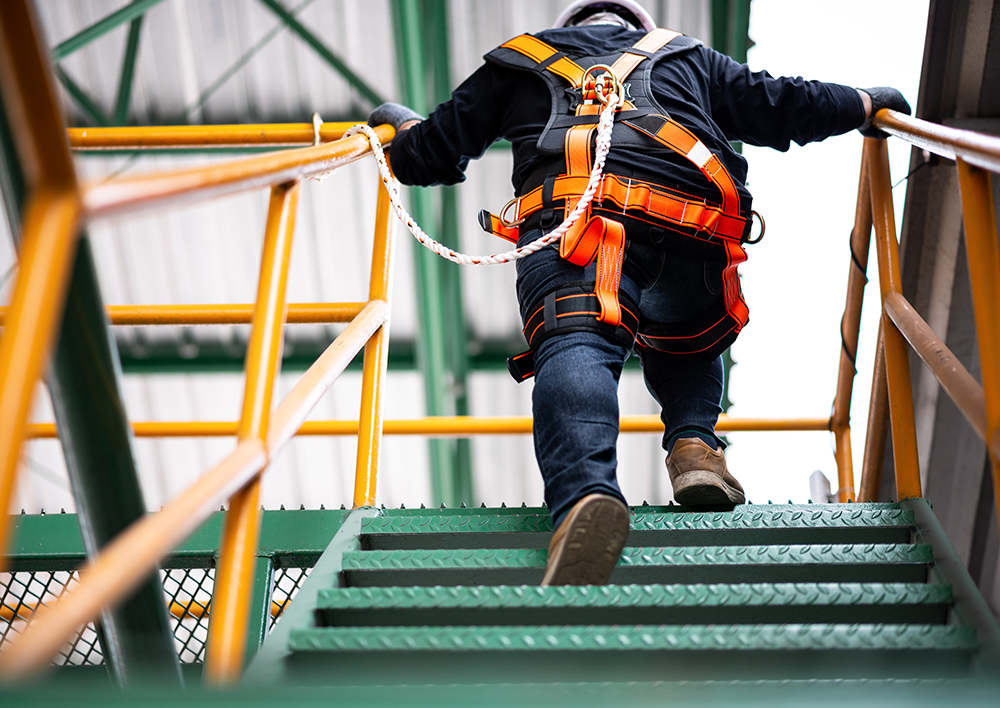
Worker with Fall Protection Equipment

Rigs and Elevated Platforms Create Complex Fall Hazards

Oilfield elevated work is rarely simple.

Workers may access fixed ladders, rig floors, tank tops, platforms, walkways, truck beds, maintenance structures, scaffolds, stairs, and temporary access points. The work may involve tools, hoses, equipment, slick surfaces, weather exposure, poor lighting, or changing site conditions.

Common fall hazards include:

  • Unprotected edges
  • Open hatches
  • Fixed ladder access points
  • Uneven or damaged walking surfaces
  • Slippery stairs or platforms
  • Weather-exposed work areas
  • Tank access points
  • Improperly guarded openings
  • Temporary platforms
  • Poor lighting
  • Inadequate anchor points
  • Obstructed walking paths
  • Tool carrying while climbing
  • Swing fall hazards

A strong program starts by identifying where workers can fall, how far they can fall, what they could strike, and what system will prevent or arrest the fall.

Compliance Cannot Stop at “Wear a Harness”

A harness is only one part of fall protection.

Workers also need the right connector, anchor point, clearance, fit, training, inspection process, and rescue plan. If any part of the system is missing, the worker may still be exposed.

A personal fall arrest system should be evaluated as a complete system:

  • Full-body harness
  • Lanyard or self-retracting lifeline
  • Connector
  • Anchorage
  • Clearance distance
  • Swing fall exposure
  • Rescue plan
  • Worker training
  • Inspection status
  • Compatibility with other PPE

The uploaded draft highlights that having certified anchors and proper equipment does not complete the system if total fall distance is not calculated correctly.

That is a critical point. A worker can be wearing a harness and still hit a lower level if the fall distance is not understood.

Total Fall Distance Must Be Calculated Before Work Begins

Total fall distance is one of the most important factors in fall protection planning.

It is not enough to know that a worker is tied off. The safety team must know whether the system will stop the worker before they contact the ground, a lower platform, equipment, piping, railing, structure, or other obstruction.

Total fall distance can include:

  • Free fall distance
  • Deceleration distance
  • Harness stretch
  • D-ring shift
  • Connector length
  • Worker height
  • Safety margin
  • Swing fall effects

The uploaded draft notes that OSHA recommends including a safety factor of at least 2 feet in the formula and warns that failing to calculate total fall distance can allow workers to strike lower levels despite wearing a harness.

For teams planning elevated work, Arbill’s guide on calculating total fall distance provides helpful context for understanding clearance factors before a worker ties off.

On rigs and platforms, clearance can change quickly. The same lanyard may be acceptable in one location and unsafe in another. That is why clearance planning must happen before the task begins.

Selecting the Right Fall Protection Equipment

Fall protection equipment should match the hazard, work location, worker, and task.

A worker climbing a fixed ladder may need a different system than a worker servicing equipment on a platform. A worker on a tank top may need different protection than a worker near a loading area. A worker exposed to low clearance may need a self-retracting lifeline instead of a longer shock-absorbing lanyard.

Common fall protection equipment may include:

  • Full-body harnesses
  • Shock-absorbing lanyards
  • Self-retracting lifelines
  • Anchor connectors
  • Horizontal lifelines
  • Vertical lifelines
  • Ladder safety systems
  • Guardrails
  • Travel restraint systems
  • Positioning systems
  • Safety nets
  • Rescue and retrieval systems
  • Tool tethering systems

For teams sourcing equipment, fall protection equipment should be selected based on the task, fall exposure, anchorage, clearance, and jobsite conditions.

The right equipment is not always the cheapest option. It is the option that protects the worker for the actual work being performed.

As long as people go to work, we have an opportunity to help protect them.

Julie Copeland
Arbill CEO

Julie Copeland Arbill CEO

Guardrails, Restraint, and Fall Arrest Are Different Controls

Fall protection systems are not interchangeable.

Guardrails are passive systems that help keep workers away from fall hazards. Travel restraint systems are designed to prevent a worker from reaching the edge. Personal fall arrest systems stop a worker after a fall begins. Positioning systems support workers while they perform tasks, but may need a backup fall arrest system depending on the exposure.

Using the wrong system can create risk.

For example, a fall arrest system requires enough clearance for the worker to stop safely. A restraint system must be set up so the worker cannot reach the edge. Guardrails must meet strength and configuration criteria. A positioning system should not be mistaken for full fall arrest protection unless the system is designed and used that way.

A strong program defines which control is required for each task.

Anchor Points Need Verification

An anchor point is not acceptable just because it looks strong.

Anchor points must be capable of supporting the required load for the system being used. The uploaded draft notes that anchor points require qualification by a structural engineer to ensure they meet OSHA strength requirements.

This matters on rigs and elevated platforms because workers may be tempted to tie off to nearby rails, pipes, structural members, or equipment. Not every convenient connection point is a safe anchor.

A program should define:

  • Approved anchor points
  • Prohibited tie-off points
  • Inspection requirements
  • Load requirements
  • Engineering review needs
  • Temporary anchor procedures
  • Rescue access considerations
  • Worker training on anchor selection

If workers have to guess where to tie off, the program is not strong enough.

Inspections Cannot Be Skipped

Fall protection equipment must be inspected before use and removed from service when damaged, worn, contaminated, or questionable.

Oilfield environments can be hard on equipment. Harnesses and lanyards may be exposed to oil, chemicals, UV, dirt, abrasion, moisture, and rough storage. Connectors may corrode. Webbing may fray. Labels may become unreadable. Self-retracting lifelines may be dropped or exposed to impact.

Workers should inspect:

  • Webbing
  • Stitching
  • D-rings
  • Buckles
  • Labels
  • Snap hooks
  • Carabiners
  • Shock packs
  • Lanyards
  • SRL housings
  • Cable or web lifelines
  • Anchor connectors
  • Signs of chemical or heat damage
  • Signs of fall arrest loading

Any equipment involved in a fall must be removed from service immediately and handled according to the employer’s program and manufacturer instructions.

Inspection is not an administrative step. It is the last chance to catch equipment failure before someone depends on the system.

Training Turns Equipment Into Protection

Fall protection equipment only works when workers know how to use it correctly.

Training should be practical and specific to the work. Workers should understand how to recognize fall hazards, inspect equipment, fit a harness, connect to an approved anchor point, avoid swing falls, understand clearance, and follow rescue procedures.

Training should cover:

  • Fall hazard recognition
  • Harness fit and adjustment
  • Lanyard and SRL selection
  • Anchor point selection
  • Total fall distance
  • Swing fall hazards
  • Ladder safety
  • Guardrails and restraint systems
  • Equipment inspection
  • Removal from service
  • Rescue planning
  • Stop-work authority

The uploaded draft notes that budget cuts often target training hours first, leaving workers less prepared to identify hazards or use equipment correctly.

That is a risk no site can afford.

Companies can also work with Arbill for safety products, services, and support to strengthen PPE programs and worker readiness.

See Our Safety Services!
Fall Prevention Training

Rescue Planning Must Be Included

A fall arrest system may stop the fall, but it does not complete the rescue.

A suspended worker may be unable to self-rescue. Delay can create serious medical risk. Rescue planning should be completed before elevated work begins, not after a fall happens.

A rescue plan should answer:

  • How will workers call for help?
  • Who will respond?
  • What rescue equipment is available?
  • Can the worker self-rescue?
  • Is assisted rescue required?
  • How quickly can rescue occur?
  • Can emergency services access the location?
  • What if the worker falls from a platform, tank, ladder, or rig structure?
  • How will the incident be documented and reviewed?

Fall protection without rescue planning is incomplete.

The Real Cost of Cutting Fall Protection

Cutting fall protection costs does not eliminate the expense. It delays it.

If equipment fails, training is incomplete, or hazards go uncorrected, the cost can show up as injuries, OSHA citations, lost time, project delays, workers’ compensation claims, insurance increases, litigation, and damaged trust with the workforce.

The uploaded draft notes that the real cost of non-compliance goes beyond citations and can include legal liability, worker injuries, lost productivity, project delays, and insurance premium increases.

Prevention costs less than correction.

A strong fall protection program may require investment, but that investment protects workers and reduces the risk of much larger losses later.

Smart Budgeting Protects Workers and Controls Costs

A safety budget should focus on smarter management, not weaker protection.

Instead of cutting fall protection, sites can look for ways to reduce waste, standardize equipment, improve storage, train workers more effectively, and replace damaged gear before it creates an incident.

Smart strategies include:

  • Prioritizing high-risk work areas first
  • Standardizing approved equipment
  • Tracking inspection and replacement schedules
  • Maintaining clear equipment ownership
  • Improving storage conditions
  • Training workers to reduce misuse
  • Reviewing near misses and incidents
  • Planning inventory for peak work periods
  • Selecting durable equipment suited to the environment
  • Documenting inspections and corrections

The goal is to spend wisely while keeping critical controls in place.

Building a Stronger Fall Protection Program

A strong program starts with the worksite.

Walk the rigs, platforms, ladders, tanks, truck access points, elevated walkways, maintenance areas, and temporary work locations. Identify where workers are exposed and what systems are required.

A practical fall protection program should include:

  • Fall hazard assessment
  • Equipment selection by task
  • Approved anchor points
  • Total fall distance calculations
  • Written procedures
  • Worker training
  • Pre-use inspections
  • Removal-from-service rules
  • Storage requirements
  • Rescue planning
  • Documentation
  • Program review when work changes

The program should be simple enough for workers to follow and strong enough to protect them in real field conditions.

Conclusion

Fall protection on rigs and elevated platforms cannot be cut with the budget.

The work is too high-risk, the conditions are too variable, and the consequences are too serious. OSHA expects employers to protect workers from fall hazards before the work begins. That means assessing the hazard, selecting the right system, verifying anchorage, calculating fall distance, inspecting equipment, training workers, and planning rescue.

A fall protection program is not just a compliance requirement. It is a life-saving system.

When workers are above ground level, every component matters. The harness, anchor, connector, clearance, training, inspection, and rescue plan all have to work together.

That is the standard worth funding.

Request a Safety Assessment

Recent Posts

Worker with Fall Protection Equipment
Fall Protection on Rigs and Elevated Platforms: The Compliance Standards That Can\’t Be Cut With the Budget

Fall Protection on Rigs and Elevated Platforms: The Compliance Standards That Can\’t Be Cut With the Budget

Worker Use Portable Gas Monitors Before Entering Confined Spaces
Gas Detection in the Field: What Your Oilfield Workers Need to Know Before Entering Any Confined Space

Gas Detection in the Field: What Your Oilfield Workers Need to Know Before Entering Any Confined Space

PPE for Utility Field Workers
From Substations to Stormwork: Building a Weather-Ready PPE Program for Utility Field Workers

From Substations to Stormwork: Building a Weather-Ready PPE Program for Utility Field Workers

Electrical Glove Testing During Work
Electrical Glove Testing Programs: The OSHA Requirement Most Utility Safety Managers Are Quietly Ignoring

Electrical Glove Testing Programs: The OSHA Requirement Most Utility Safety Managers Are Quietly Ignoring

Arc flash protection PPE
Arc Flash, Electrical Shock, and Line Work: Why Utilities Need a Layered PPE Strategy — Not Just a Checklist

Arc Flash, Electrical Shock, and Line Work: Why Utilities Need a Layered PPE Strategy — Not Just a Checklist