Cut-resistant gloves are not a one-size-fits-all safety product.

A glove that performs well while handling sheet metal may be unnecessarily bulky for assembly work. Protection suitable for warehouse packaging may be inadequate around broken glass. A glove with excellent cut resistance may also perform poorly when workers need chemical resistance, heat protection, grip on oily surfaces, or precise finger movement.

That is why selecting the highest available cut level is not automatically the safest decision.

Effective glove selection begins with understanding the task, identifying how cuts could occur, evaluating the severity and frequency of exposure, and balancing protection with dexterity, grip, fit, comfort, and other workplace hazards.

For industrial organizations evaluating hand protection, Arbill provides safety products, assessments, training, and PPE program support designed around actual workplace conditions.

Understanding Cut-Resistant Glove Ratings

Cut ratings provide a standardized way to compare glove performance, but the rating is only one part of the selection process.

ANSI/ISEA 105 Cut Levels

ANSI/ISEA 105-2024 is the current American National Standard covering classification and testing of hand and arm protection for several performance characteristics, including cut, puncture, abrasion, chemical, and heat resistance.

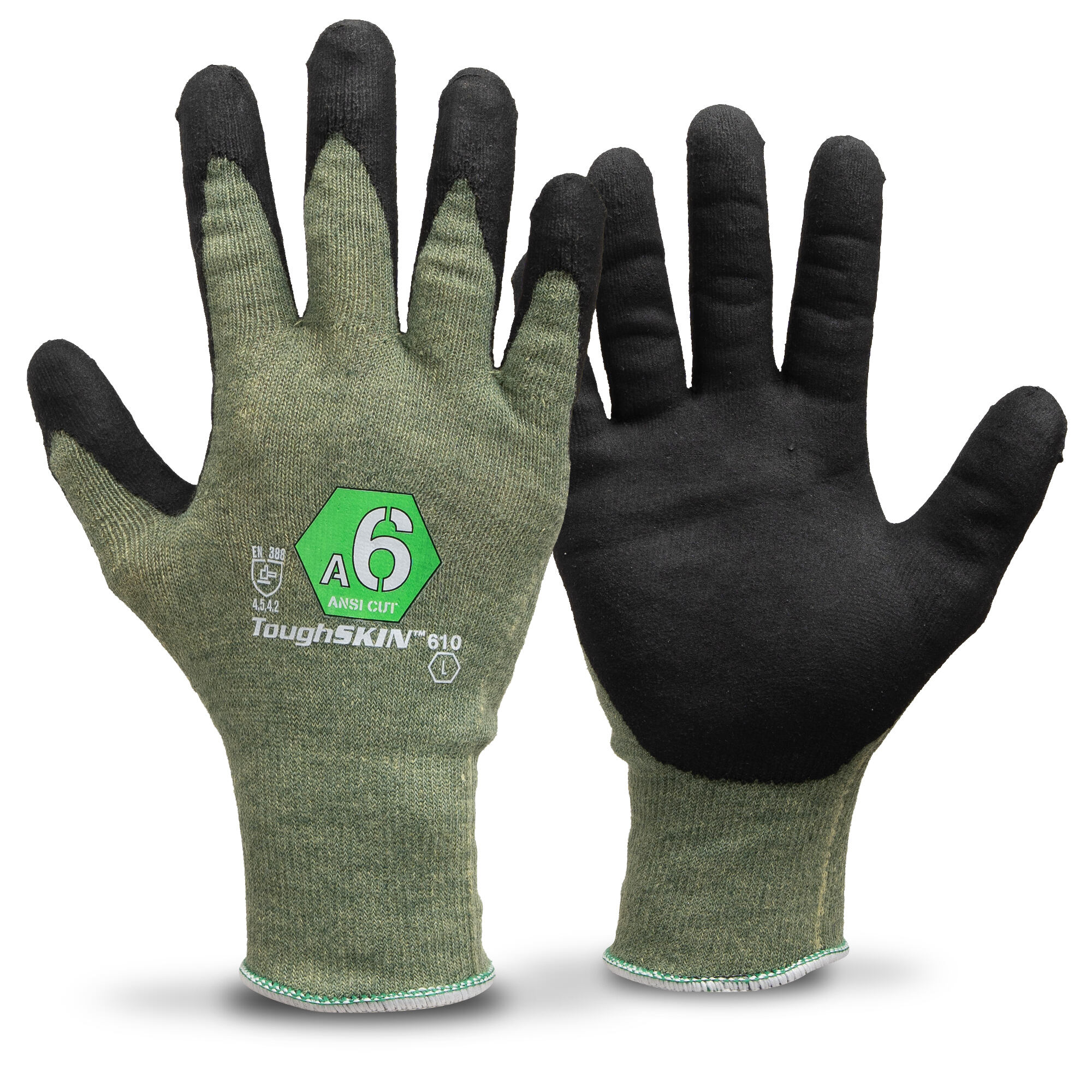
For cut resistance, the standard uses nine levels ranging from A1 through A9.

A1 represents the lowest resistance within the rated scale, beginning at 200 grams of cutting load. Protection increases through A9, which represents 6,000 grams or more.

In practical terms, lower levels may be appropriate for lighter material handling and assembly tasks, while higher ratings are commonly considered where workers encounter sharp metal, glass, recycling materials, or other severe cutting hazards.

However, a higher number does not mean the glove is automatically better for every job.

A worker assembling small components may lose too much dexterity in a heavy A8 or A9 glove. Conversely, an employee handling razor-sharp sheet metal may need substantially more protection than a lightweight glove provides.

The assessment should determine the appropriate level.

ANSI Ratings Measure Tested Performance

The rating represents laboratory-tested material performance under standardized conditions.

It does not mean the glove is “cut-proof.”

Workers can still be injured when the cutting force, blade geometry, contact angle, impact, puncture force, or working conditions exceed the glove’s tested capability.

Training should make this limitation clear. Cut-resistant gloves reduce risk and potential injury severity but do not replace safe handling practices, guarding, automation, or other hazard controls.

EN 388 Ratings

Organizations purchasing gloves internationally may also encounter EN 388 markings.

EN 388 evaluates mechanical hazards such as abrasion, cut, tear, and puncture resistance. Modern versions also use an ISO 13997 cut test represented by letter ratings.

Because ANSI/ISEA 105 and EN 388 use different classification systems, the numbers or letters should not be compared directly.

When facilities operate across several countries, procurement teams should verify which test standard and edition appears on the product rather than assuming equivalent-looking markings provide identical performance.

Start With a Hand Hazard Assessment

Glove selection should begin at the workstation—not with a product specification sheet.

Identify How Employees Can Be Cut

Observe the materials workers handle and the motions they perform.

Cut hazards may come from sheet metal, glass, blades, stamped parts, wire, sharp plastic, scrap, tools, packaging materials, unfinished components, or broken materials.

The mechanism matters.

A smooth but razor-sharp sheet edge creates a different hazard from jagged demolition debris. A worker drawing a knife toward the hand faces a different exposure from someone carrying glass sheets.

Understanding how contact could occur helps determine how much cut resistance and what other glove properties are needed.

Evaluate the Frequency of Exposure

A worker handling sharp parts throughout an entire shift faces a different risk profile from an employee performing the same activity for ten minutes each week.

Consider both frequency and duration.

Repeated exposure may justify stronger protection, but full-shift use also makes comfort, breathability, fit, and flexibility particularly important.

A protective glove that employees remove because it becomes uncomfortable does not provide effective protection.

Consider the Consequence

Ask what could happen if the glove fails.

A superficial cut from cardboard and a severe laceration from sheet steel should not be evaluated the same way.

Higher-consequence tasks may justify higher cut levels or additional controls, even when the activity is performed infrequently.

Arbill’s EHS safety assessments can help organizations evaluate workplace hazards, PPE needs, work practices, training, and broader compliance gaps.


Explore Our Solutions!
Cut-Resistant Gloves for Welding and Metal Fabrication

Select the Right Coating

The glove coating can affect grip, durability, liquid resistance, and worker comfort just as much as the cut-resistant liner.

Polyurethane

Polyurethane coatings are often used where workers need dexterity and grip in relatively dry environments.

They can provide a thin gripping surface that allows employees to handle smaller components without excessive bulk.

Nitrile

Nitrile coatings can perform well where workers encounter oils, grease, or industrial materials.

Different nitrile formulations provide different levels of grip and liquid resistance, so the specific product should be evaluated against workplace conditions.

Foam Coatings

Foam-style coatings can improve grip by channeling certain liquids away from the contact surface while maintaining flexibility.

They may be useful in environments where workers handle lightly oily components throughout the shift.

The coating should support the actual task rather than being selected solely according to preference.

Fit and Dexterity Matter

A technically impressive glove can still create problems if workers cannot use their hands effectively.

Oversized Gloves

Loose gloves may bunch around the fingertips, reduce tactile control, and potentially catch on equipment.

Workers may grip materials harder to compensate, increasing fatigue.

Gloves That Are Too Tight

Overly tight gloves can restrict movement and circulation.

They may also fatigue the hands more quickly during repetitive tasks.

Proper sizing should allow workers to move naturally without excess loose material.

Dexterity Requirements

Assembly employees, technicians, mechanics, and quality inspectors may need to manipulate fasteners, connectors, controls, tools, or electronic devices.

Increasing cut resistance often introduces some trade-off in thickness or stiffness, although modern materials have reduced this problem significantly.

The selected glove should provide adequate protection without creating a new hazard by making the task unnecessarily difficult.

Match Gloves to Your Industry

Industry can provide a useful starting point, but the final selection should always be task-specific.

Manufacturing and Assembly

Manufacturing employees may encounter sharp stamped parts, plastic components, packaging, metal edges, tools, and machine parts.

Light and moderate cut hazards often require a balance between protection and fine motor control.

Instead of assigning one glove to an entire facility, assess production tasks individually. A final assembly employee handling small components may need a different glove from an employee removing sharp parts from a stamping operation.

Arbill’s heavy industrial manufacturing safety solutions address broader hazards found in metal, steel, fabrication, and high-risk industrial environments.

Metal Fabrication

Sheet metal, burrs, unfinished edges, stamped pieces, and scrap can create significant laceration hazards.

Higher cut levels may be appropriate where workers routinely handle sharp metal, but the assessment should also examine abrasion, heat, oil, and grip.

A metal worker handling oily parts may benefit from a different coating than someone handling clean, dry sheet stock.

Welding and hot-work tasks may require additional thermal performance that a standard cut-resistant glove does not provide.

Glass Handling

Glass creates a combination of cut and puncture hazards.

Broken or unfinished edges can cause severe injuries, and larger sheets can create substantial force against the hand.

Higher cut levels are often considered for these applications, but employers should also evaluate puncture resistance, forearm protection, grip, and whether the glove remains secure when handling smooth surfaces.

Sleeves may be necessary when sharp material can contact the wrist or forearm.

Construction

Construction employees may handle metal studs, sharp tools, wire, lumber, roofing materials, sheet products, and demolition debris.

The hazards change frequently as projects progress.

Cut resistance therefore needs to be balanced with abrasion durability, puncture resistance, grip, weather conditions, and the ability to operate tools safely.

A glove suitable for finish work may not be appropriate for demolition.

Warehousing and Distribution

Warehouse workers may encounter cardboard, straps, pallets, sharp packaging, damaged products, and utility knives.

Many of these tasks require high dexterity and long wear periods.

Using unnecessarily heavy gloves can reduce efficiency without creating a meaningful safety benefit.

Hazard assessment should determine whether employees need light cut resistance or stronger protection for specific departments.

Food Processing

Knife work, deboning, slicing equipment, and sharp processing tools can produce serious hand injuries.

Gloves may need strong cut resistance while also meeting hygiene, sanitation, moisture, and food-contact requirements.

The product should be evaluated according to the specific task, food handling requirements, cleaning process, and applicable regulatory requirements rather than relying solely on the ANSI cut level.

As long as people go to work, we have an opportunity to help protect them.

Julie Copeland
Arbill CEO

Julie Copeland Arbill CEO

Consider Sleeves and Forearm Protection

Hand injuries are not the only concern when employees handle sheet metal, glass, scrap, or other large sharp materials.

A glove may stop at the wrist while the task exposes the forearm.

ANSI/ISEA 105-2024 expanded its scope to address both hand and arm protection, including gloves and sleeves.

Where exposure extends beyond the hand, assess whether cut-resistant sleeves or other arm protection are needed.

The sleeve should remain compatible with the glove, clothing, and task so that gaps do not develop between protective components.

Let Workers Test Gloves Before Standardizing

Product specifications cannot reveal every practical problem.

Before making a large purchase, allow employees who perform the task to trial several approved options.

Ask them about grip, dexterity, heat buildup, pressure points, finger movement, fatigue, and how well the glove performs with actual materials and tools.

Worker feedback should not override necessary protection, but it can help determine which compliant option employees are most likely to wear correctly.

Testing can also prevent an organization from standardizing a product that appears strong on paper but performs poorly in real operations.

Train Employees on Glove Limitations

Cut-resistant does not mean cut-proof.

Workers should understand the protection level, intended application, and limitations of their gloves.

Training should explain when gloves are required, how to inspect them, when they must be replaced, and which tasks require different hand protection.

Employees should also understand that certain moving machinery may create entanglement hazards where wearing gloves could increase risk. Glove use should always be evaluated within the full task and machine-safety procedure.

Arbill’s EHS safety training can support PPE education and other industrial hazard-control programs.

Inspect and Replace Gloves

Cut-resistant materials do not maintain full performance indefinitely.

Daily use, abrasion, contamination, washing, heat, chemicals, and repeated flexing can reduce performance.

Workers should inspect gloves before use for cuts, holes, thinning material, damaged seams, coating separation, or other deterioration.

Replacement should be based on condition, workplace exposure, manufacturer recommendations, and observed service life rather than using one arbitrary schedule for every task.

Employees should also be able to obtain replacements easily.

PPE vending solutions can help place approved gloves closer to workers while giving safety and purchasing teams better visibility into product consumption and inventory.

Review Glove Performance Over Time

Selection should not end after the first order.

Review hand injuries, near misses, glove consumption, worker feedback, and observed glove condition regularly.

Unexpectedly high consumption may indicate that a glove is wearing out too quickly for the task.

Low consumption may mean the product is durable—or that employees are not wearing it consistently.

If hand injuries continue despite glove use, reassess the hazard instead of automatically moving to a higher cut level.

The underlying problem may involve inadequate guarding, poor material handling, unsuitable tools, insufficient training, or the wrong type of protection.

See Our Safety Services!
Arbill cut-resistant gloves

Common Cut-Resistant Glove Selection Mistakes

One of the most common mistakes is automatically selecting the highest ANSI rating available.

More protection is valuable only when it matches the hazard and still allows the employee to perform the job safely.

Another mistake is focusing entirely on cut resistance while ignoring puncture, abrasion, chemicals, temperature, grip, and compatibility.

Facilities may also standardize one glove across an entire organization even though different departments face different hazards.

Finally, employers sometimes select gloves without involving workers or conducting field trials. This can result in technically compliant products that employees avoid because they are uncomfortable or interfere with the job.

A Practical Selection Process

A strong glove selection process begins by identifying the exact task and the cutting mechanism. Evaluate the potential severity, frequency, and duration of exposure, then consider any additional hazards such as puncture, chemicals, heat, abrasion, or oil.

Use ANSI/ISEA 105 ratings and manufacturer performance data to identify appropriate products. Then evaluate fit, dexterity, grip, coating, comfort, and compatibility with other PPE.

Trial suitable products with the employees who perform the work and monitor their performance before standardizing them across the department.

Finally, train workers, establish inspection and replacement procedures, and reassess the selection when tasks, materials, or workplace conditions change.

Conclusion

Choosing the right cut-resistant gloves requires more than finding the highest number on a product label.

ANSI/ISEA 105 ratings provide a valuable way to compare cut performance, but effective hand protection depends on matching that performance to the actual workplace hazard.

Employers should consider how employees could be cut, the severity and frequency of exposure, required dexterity, glove fit, grip, abrasion, puncture, chemicals, temperature, and other task-specific conditions.

The best glove is not necessarily the thickest or most protective model available. It is the glove that provides the necessary protection while allowing employees to perform their work safely and consistently.

When glove selection is supported by hazard assessment, employee testing, proper training, accessible replacements, and ongoing performance review, organizations can reduce hand injuries without sacrificing productivity or worker acceptance.

Request a Safety Assessment

Recent Posts

Workplace Safety Programs
How to Improve Safety Culture in Industrial Workplaces

How to Improve Safety Culture in Industrial Workplaces

Essential Guide to Preventing Workplace Eye Injuries
Workplace Eye Injuries: Causes, Prevention, and PPE Solutions

Workplace Eye Injuries: Causes, Prevention, and PPE Solutions

First Aid SmartCompliance
How Often Should First Aid Kits Be Inspected and Restocked?

How Often Should First Aid Kits Be Inspected and Restocked?

How to Implement Lockout Tagout Procedures in Manufacturing
Lockout/Tagout Best Practices for Manufacturing Facilities

Lockout/Tagout Best Practices for Manufacturing Facilities

Safety Glasses Side Sheilds
How to Select the Best Safety Glasses for Different Job Sites

How to Select the Best Safety Glasses for Different Job Sites

  • Previous ProjectFall Protection Requirements Every Employer Should Know

  • Next ProjectHow to Perform a PPE Hazard Assessment

CUSTOMER SERVICE

800-523-5367

CONTACT US

Complete the short form below and an Arbill representative will get back to you within 24 hours.
* Required Fields

    ARBILL RESPECTS YOUR PRIVACY AND YOUR INFORMATION: By submitting the form above you agree to receiving emails from Arbill. Your submitted information is NEVER shared. You may unsubscribe at any time via the "unsubscribe" link in our emails. You can view our Privacy Policy HERE.