Falls remain one of the most serious hazards in construction and industrial work. Employees may be exposed while working near roof edges, elevated platforms, floor openings, scaffolds, ladders, mezzanines, aerial equipment, loading areas, or temporary structures.

The challenge is that fall protection requirements are not based on one simple height rule that applies to every task.

OSHA requirements vary according to the type of work, walking-working surface, industry, fall distance, and protection system being used. Employers must identify the exposure first, determine which standard applies, select an appropriate control, provide compliant equipment, and train employees before work begins.

For organizations trying to identify fall hazards before an incident occurs, Arbill’s EHS safety assessments can help evaluate workplace conditions, PPE, written programs, training records, and compliance gaps across industrial operations.

OSHA’s Construction Fall Protection Framework

For construction work, OSHA Subpart M provides the primary fall protection requirements.

1926.501: When Fall Protection Is Required

29 CFR 1926.501 establishes the employer’s duty to provide fall protection.

OSHA requires employers to first determine whether the walking or working surface has enough structural strength and integrity to support employees safely. Workers should not be permitted to work on the surface until that determination has been made.

For unprotected sides and edges, employees working 6 feet or more above a lower level generally must be protected by a guardrail system, safety net system, or personal fall arrest system.

The standard also contains task-specific requirements for leading edges, holes, hoist areas, formwork, ramps, runways, excavations, roofing work, wall openings, and other exposures.

1926.502: How Fall Protection Systems Must Perform

Once protection is required, 1926.502 establishes performance and installation criteria.

For example, guardrail top edges generally must be 42 inches plus or minus 3 inches above the walking-working surface and must withstand at least 200 pounds of force applied outward or downward near the top edge. Midrails and similar intermediate members generally must withstand at least 150 pounds.

Personal fall arrest systems must also meet specific requirements involving anchorage, connectors, free-fall distance, arresting forces, and clearance.

1926.503: Training Requirements

OSHA requires employers to train every employee who may be exposed to a fall hazard.

The training must enable employees to recognize fall hazards and understand the procedures used to minimize those hazards. A competent person must provide the necessary instruction.

Employers must also prepare a written certification record containing the employee’s identity, training date, and the signature of the trainer or employer.

Explore Our Solutions!
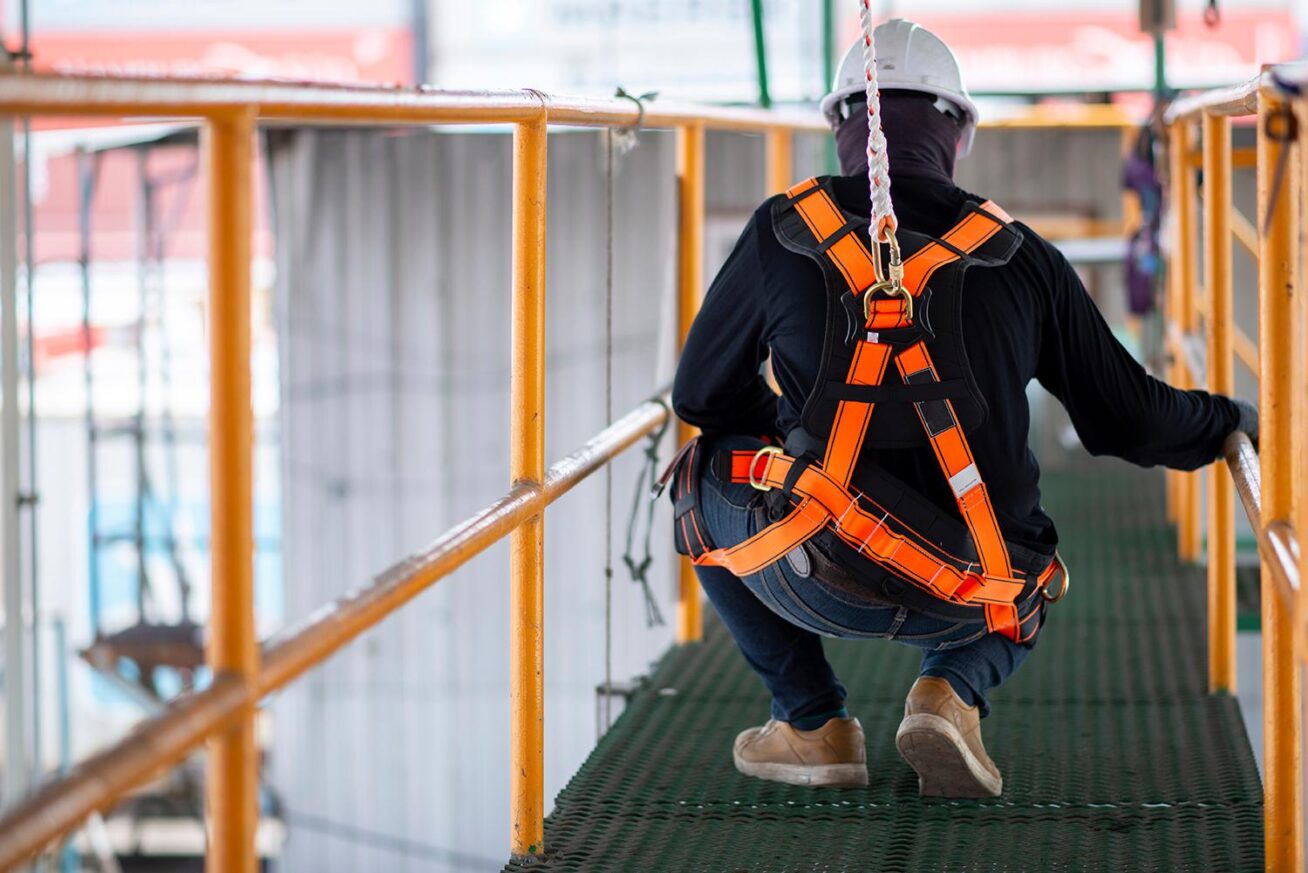
Construction worker wearing safety harness and safety line working on construction

The Six-Foot Rule Is Not Universal

One of the most common fall protection mistakes is assuming that six feet is the only threshold an employer ever needs to remember.

Construction Work

For many construction activities involving unprotected sides and edges, protection is required at six feet.

However, separate OSHA provisions apply to scaffolds, steel erection, ladders, and certain other work.

Scaffold requirements, for example, generally trigger fall protection at heights greater than 10 feet above a lower level.

Steel erection has its own Subpart R requirements and thresholds.

Employers should always identify the task and applicable standard before deciding which height threshold applies.

General Industry Is Different

Manufacturing plants, warehouses, utilities, and other general industry facilities primarily follow OSHA 29 CFR Part 1910 rather than construction Subpart M.

General industry walking-working surface requirements can differ from construction requirements.

This distinction becomes particularly important when maintenance, renovation, installation, or construction work occurs inside an industrial facility.

The employer should determine which regulatory framework applies to the specific activity rather than relying solely on the company’s industry classification.

Conduct a Fall Hazard Assessment Before Work Begins

Fall protection should be planned before employees approach an elevated work area.

Inspect the Walking-Working Surface

Confirm that the surface is structurally capable of supporting employees and their equipment.

Evaluate roofs, platforms, temporary decking, scaffolds, elevated structures, access points, and any surface that could deteriorate or fail.

Fragile roofs, skylights, corroded structures, or incomplete decking may create hazards that are not obvious from ground level.

Identify Fall Edges and Openings

Look for roof edges, floor openings, stairwells, elevator shafts, pits, wall openings, leading edges, and unfinished building perimeters.

These hazards often change as construction or maintenance progresses.

A previously protected opening may become exposed after equipment, barriers, or temporary covers are removed.

Consider Weather and Housekeeping

Rain, ice, snow, mud, oils, loose debris, or poor lighting can significantly increase fall risk.

Fall planning should therefore consider not only the edge itself but also the conditions that could cause an employee to slip, trip, or lose balance near it.

Guardrail Systems

Guardrails are often one of the most effective options because they provide passive protection.

Employees do not need to attach or detach equipment for the system to work.

Basic Guardrail Criteria

Under OSHA construction requirements, top rails generally must be positioned 42 inches ±3 inches above the working surface. Where there is no wall or parapet at least 21 inches high, midrails, screens, mesh, or equivalent protection must generally be provided.

Top rails must withstand at least 200 pounds of outward or downward force.

Guardrails must also be constructed so they do not create puncture, laceration, or snagging hazards.

Toeboards and Falling Objects

Fall protection is not only about preventing employees from falling.

Tools and materials can also fall onto employees working below.

Where toeboards are required, OSHA specifies minimum height and strength requirements. Additional screening or paneling may be necessary when materials are stacked above the top of the toeboard.

As long as people go to work, we have an opportunity to help protect them.

Julie Copeland
Arbill CEO

Julie Copeland Arbill CEO

Personal Fall Arrest Systems

Personal fall arrest systems are commonly used when employees must work close to an exposed edge and guardrails or other passive systems are impractical.

Arbill offers a range of fall protection equipment for industrial and construction applications, but equipment should always be selected based on the actual task, anchorage, clearance, and applicable OSHA requirements.

Anchorage Strength

A commonly cited OSHA requirement is that anchorages used for personal fall arrest equipment must support at least 5,000 pounds per employee attached.

There is an important alternative: the anchorage may instead be designed, installed, and used as part of a complete personal fall arrest system that maintains a safety factor of at least two and operates under the supervision of a qualified person.

This distinction matters because employers should not assume that every acceptable engineered anchorage must literally be rated at exactly 5,000 pounds.

Fall Distance and Clearance

A worker can wear a compliant harness and still strike a lower level if the system is poorly designed.

The employer must consider free-fall distance, deceleration distance, worker height, connector length, harness stretch, anchor position, and the clearance below the work surface.

Swing-fall exposure should also be evaluated when the anchorage is positioned far to the side of the employee.

Equipment Inspection

Harnesses, lanyards, connectors, self-retracting lifelines, and other PFAS components should be inspected before use according to applicable OSHA requirements and manufacturer instructions.

Equipment showing cuts, burns, broken stitching, deformation, corrosion, damaged hooks, or other defects should be removed from service.

Equipment subjected to impact loading during a fall should not simply be put back into circulation without following the manufacturer’s removal and inspection requirements.

Safety Net Systems

Safety nets may be appropriate where guardrails or PFAS are impractical and workers need collective protection below the work area.

Nets must be installed as close as practicable beneath the walking-working surface and must meet OSHA requirements for positioning, strength, mesh size, and inspection.

The system should also remain free from materials, tools, scrap, and debris that could injure a worker who falls into it.

Safety net installation should be planned as part of the fall protection system rather than improvised after elevated work begins.

Covers for Holes and Openings

Floor and roof openings can be easy to overlook because employees may become accustomed to walking around them.

Covers must be strong enough for expected loads, properly secured against displacement, and appropriately marked or identified.

A loose piece of plywood placed over an opening should not automatically be treated as an acceptable protective cover.

Covers should remain in place until the opening no longer exists or another compliant form of protection has been installed.

Scaffolds Require Their Own Fall Protection Planning

Scaffolds present fall hazards through incomplete platforms, missing guardrails, unstable bases, unsafe access, and improper erection.

Employers should avoid treating scaffold requirements as simply another application of the six-foot construction rule.

Fall protection requirements under OSHA’s scaffold standards generally apply when employees are more than 10 feet above a lower level.

Scaffolds should be erected, moved, dismantled, or altered under appropriate competent-person oversight and inspected for conditions that could affect structural integrity or employee protection.

Aerial Lifts and Elevated Work Platforms

Aerial equipment introduces fall and ejection hazards that differ from those on fixed platforms.

Workers should remain inside the platform and should not climb, sit, or stand on guardrails to gain additional reach.

The correct restraint or fall arrest requirements depend on the equipment type and applicable OSHA provisions.

Employers should also evaluate crushing hazards, overhead power lines, unstable ground, traffic, and equipment movement around the lift.

Fall protection should be coordinated with the equipment manufacturer’s instructions.

Fall Protection Training

Equipment cannot protect employees if they do not understand when and how to use it.

What Employees Need to Learn

OSHA 1926.503 requires training on the nature of fall hazards and the correct procedures for erecting, maintaining, disassembling, and inspecting the systems being used.

Employees also need instruction on the use and operation of guardrails, personal fall arrest systems, safety nets, warning lines, monitoring systems, and other protection applicable to their jobs.

Training should reflect the actual worksite and equipment instead of relying entirely on generic presentations.

Arbill’s EHS safety training can support fall protection education along with other workplace safety topics.

Retraining

OSHA requires retraining when there is reason to believe that an employee no longer has the required understanding or skill.

Examples include workplace changes that make previous training obsolete, changes in fall protection systems or equipment, or observed deficiencies in an employee’s knowledge or use of the system.

Employers should not wait automatically for the next annual training date when an immediate skill gap has been identified.

The Role of the Competent Person

OSHA uses the term “competent person” in many construction requirements.

For fall protection purposes, the competent person needs the ability to identify existing and predictable hazards and the authority to take prompt corrective action.

A job title alone does not make someone competent.

The employer should ensure the individual has sufficient knowledge and experience with the fall hazards and protection systems present at the site.

The competent person should also have genuine authority to stop or correct unsafe work rather than merely document it.

Fall Protection Includes More Than Harnesses

Employers sometimes equate fall protection with putting every employee in a harness.

That approach can overlook more effective controls.

Passive systems such as guardrails or properly secured covers can reduce reliance on individual employee behavior. Work platforms, scaffolds, lifts, or changes in task sequencing may remove the need for employees to approach an edge at all.

Fall protection planning should consider the hierarchy of controls and select the safest practical method for the work.

See Our Safety Services!
Fall Protection Gear

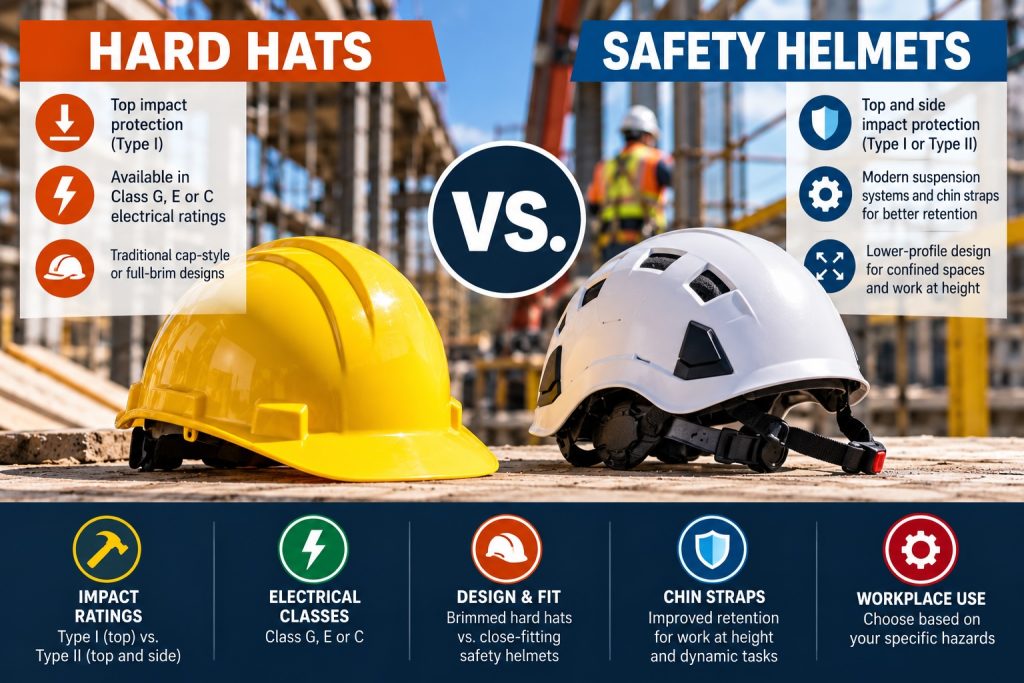
Head Protection Around Fall Hazards

Falls and falling-object hazards frequently occur in the same work areas.

Employees working below elevated operations may need appropriate head protection where objects could fall or be dropped.

Arbill’s head protection options can support industrial and construction head protection programs where impact or electrical hazards are present.

Head protection does not replace toeboards, debris nets, tool tethering, exclusion zones, or other falling-object controls. It provides another protective layer.

Foot and Leg Protection Can Reduce Secondary Fall Risk

Footwear selection can also affect fall prevention.

Poor traction, damaged soles, unsuitable footwear, and exposure to oils, water, debris, or uneven surfaces can contribute to slips and loss of balance near elevated areas.

Arbill’s foot and leg protection options can support workplace PPE programs where impact, compression, puncture, slip, chemical, or environmental hazards are present.

The footwear still needs to be selected through a task-specific PPE hazard assessment.

Plan for Rescue Before a Fall Occurs

Fall arrest stops the employee from reaching a lower level, but the emergency is not necessarily over.

A suspended worker may need prompt rescue.

Employers should determine in advance how rescue will occur, who will perform it, what equipment is required, how emergency services will be contacted, and how rescuers can reach the worker safely.

Simply relying on the local fire department without confirming response capability and access may not constitute a practical rescue plan.

Facilities should also prepare for medical emergencies that may follow a fall or rescue.

An organized AED program can support broader emergency preparedness by helping workplaces maintain AED access, oversight, supplies, training, and readiness. AEDs do not replace a fall rescue plan, but both should be integrated into a complete emergency response system.

Document Fall Protection Training

Under 1926.503, employers must prepare a written certification record verifying that required fall protection training occurred.

The record must include the employee’s name or other identity, the training date or dates, and the signature of the trainer or employer. OSHA requires the latest certification to be maintained.

Documentation is important, but the certificate should not become the purpose of the training.

The real objective is ensuring employees can recognize fall hazards and use the selected protection correctly.

Common Fall Protection Mistakes

Several recurring weaknesses appear in fall protection programs.

One is applying the six-foot rule universally without checking the applicable standard.

Another is installing anchorages without calculating clearance, swing fall, or system design.

Employers may also provide harnesses without ensuring proper fit, use generic training instead of worksite-specific instruction, or fail to retrain employees after equipment and workplace conditions change.

Other common problems include unsecured covers, incomplete guardrails, damaged fall arrest equipment, and a lack of practical rescue planning.

The presence of fall protection equipment does not automatically mean the fall hazard has been adequately controlled.

Build Fall Protection Into Job Planning

The strongest fall protection programs begin before workers arrive at the elevated task.

Job planning should identify the surface, fall height, edge or opening, access method, protection system, anchorage, equipment, rescue method, required PPE, and competent-person responsibilities.

Weather, nearby work, falling-object exposure, and changes expected during the project should also be considered.

When the work changes, the plan should change with it.

This approach helps prevent employees from reaching an elevated work area and discovering that the correct equipment or anchor point is unavailable.

Conclusion

Fall protection compliance requires more than remembering a single height threshold or issuing harnesses to employees.

Employers must determine which OSHA standard applies, inspect walking-working surfaces, identify fall exposures, and provide compliant protection before employees begin the work.

For many construction activities, unprotected sides and edges at six feet or more require protection, but separate requirements apply to scaffolds, steel erection, and other specialized activities.

Guardrails, safety nets, personal fall arrest systems, covers, and other controls must meet specific OSHA criteria. Employees must also receive appropriate training from a competent person, and employers must maintain the required training certification.

Fall protection should be supported by equipment inspection, hazard reassessment, falling-object controls, appropriate PPE, and a practical rescue plan.

When employers build these requirements into job planning instead of reacting after work begins, they can reduce serious fall exposure while strengthening compliance across the worksite.

Request a Safety Assessment

Recent Posts

Workplace Safety Programs
How to Improve Safety Culture in Industrial Workplaces

How to Improve Safety Culture in Industrial Workplaces

Essential Guide to Preventing Workplace Eye Injuries
Workplace Eye Injuries: Causes, Prevention, and PPE Solutions

Workplace Eye Injuries: Causes, Prevention, and PPE Solutions

First Aid SmartCompliance
How Often Should First Aid Kits Be Inspected and Restocked?

How Often Should First Aid Kits Be Inspected and Restocked?

How to Implement Lockout Tagout Procedures in Manufacturing
Lockout/Tagout Best Practices for Manufacturing Facilities

Lockout/Tagout Best Practices for Manufacturing Facilities

Safety Glasses Side Sheilds
How to Select the Best Safety Glasses for Different Job Sites

How to Select the Best Safety Glasses for Different Job Sites

  • Previous ProjectHow Heat Stress Affects Workers and Ways to Prevent It

  • Next ProjectChoosing the Right Cut-Resistant Gloves for Your Industry

CUSTOMER SERVICE

800-523-5367

CONTACT US

Complete the short form below and an Arbill representative will get back to you within 24 hours.
* Required Fields

    ARBILL RESPECTS YOUR PRIVACY AND YOUR INFORMATION: By submitting the form above you agree to receiving emails from Arbill. Your submitted information is NEVER shared. You may unsubscribe at any time via the "unsubscribe" link in our emails. You can view our Privacy Policy HERE.