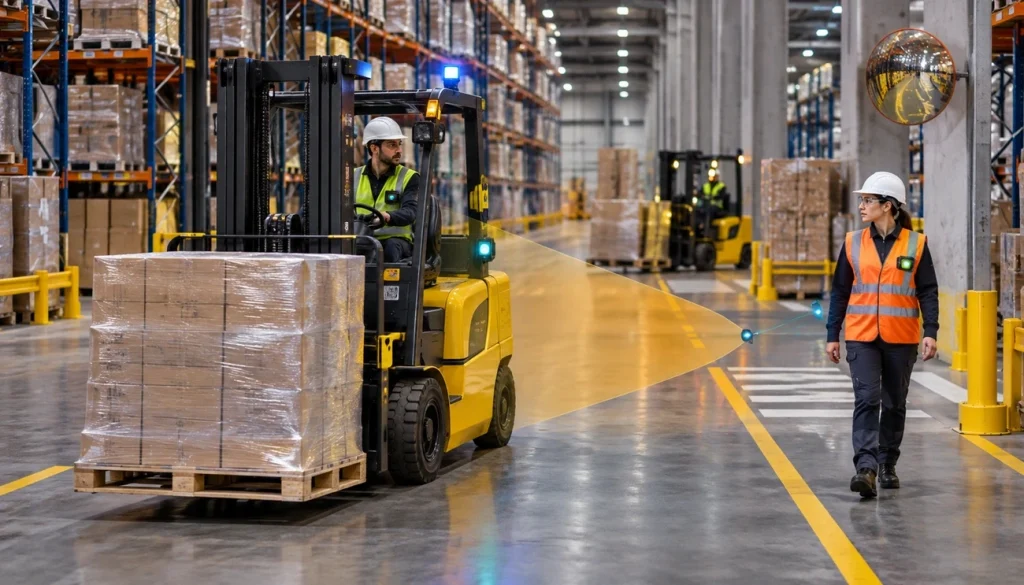
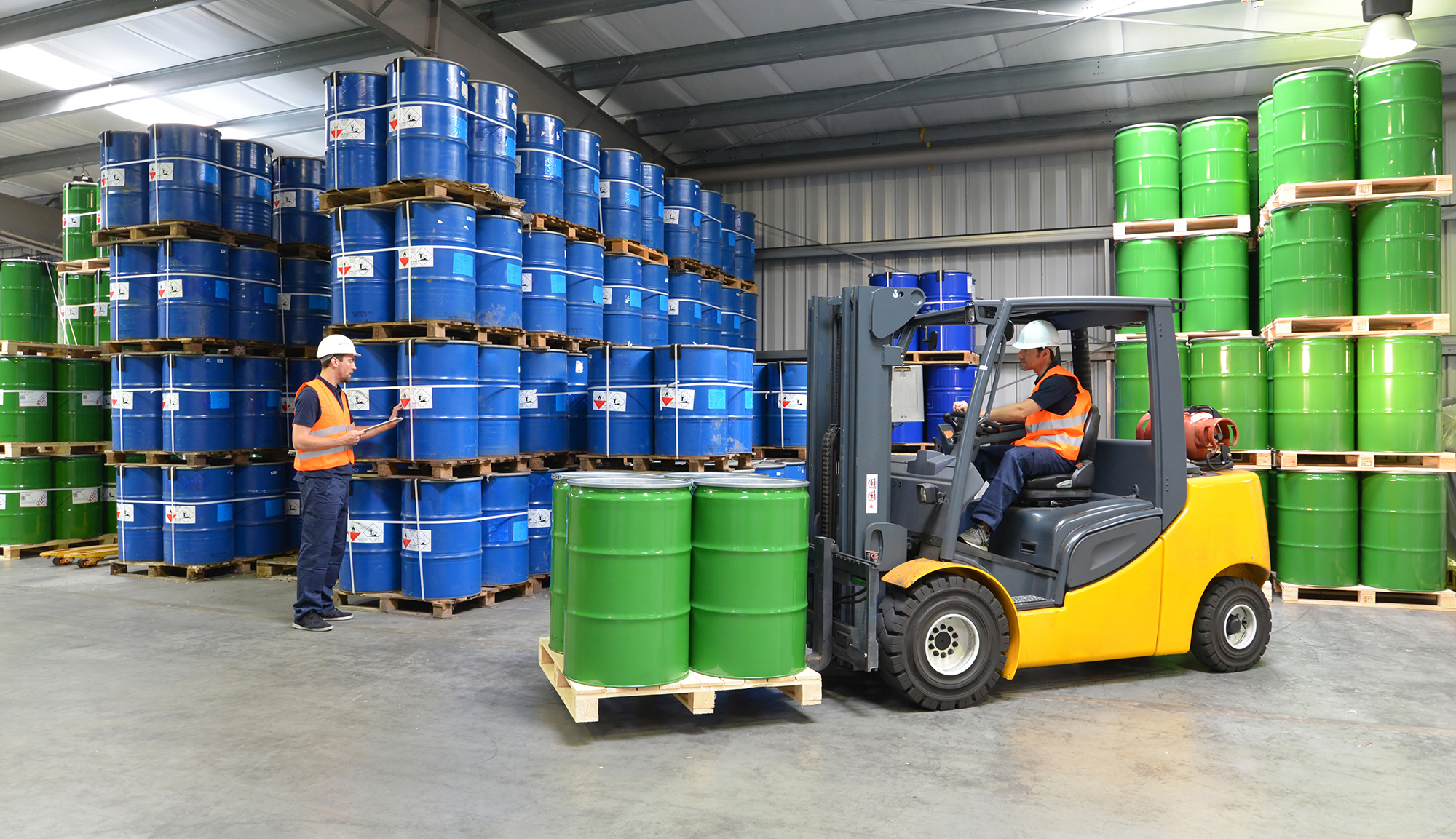
A busy warehouse can change from orderly to dangerous in seconds when a forklift and a pedestrian enter the same space.

Tall storage racks create blind intersections. Pallets temporarily block sightlines. Workers move between picking, packing, and staging areas while forklifts transport loads through the same aisles. At loading docks, pedestrians, lift trucks, trailers, and freight may all converge within a relatively small area.

Even an experienced operator cannot react to a pedestrian they cannot see, and a pedestrian may not recognize how quickly a forklift can approach, stop, turn, or swing at the rear.

Preventing collisions therefore requires more than telling employees to “watch for forklifts.”

Warehouses need traffic routes designed to separate people from equipment, properly trained operators, clear intersections, effective housekeeping, safe dock procedures, worker awareness, and additional technology where physical controls still leave significant interaction.

The strongest forklift-pedestrian safety programs treat the warehouse as a complete traffic system.

Why Forklift-Pedestrian Collisions Are a Serious Warehouse Hazard

Forklifts are designed to move heavy loads efficiently, but their operating characteristics create hazards that are very different from ordinary road vehicles.

The operator may have reduced forward visibility because of the load. Rear-wheel steering creates a wide tail swing during turns. A loaded forklift cannot necessarily stop quickly, and narrow aisles may leave little room for pedestrians to move away.

At the same time, warehouse employees often work close to active vehicle routes.

Pickers retrieve inventory from rack aisles. Shipping employees cross lanes to check freight. Maintenance personnel enter production areas. Contractors and visitors may be unfamiliar with established traffic patterns.

OSHA recommends separating forklift traffic from pedestrians where possible and using controls such as pedestrian walkways, barriers, mirrors, signs, speed controls, horns, and adequate clearance where shared areas cannot be eliminated. (OSHA Forklift Pedestrian Traffic Guidance)

The goal should be to reduce how often people and forklifts need to depend on last-second awareness.

Start by Mapping Forklift and Pedestrian Traffic

One of the best ways to understand warehouse collision risk is to observe the facility while it is operating.

A floor plan may show where aisles are supposed to be, but it does not necessarily show how employees actually move during a busy shift.

Walk through the warehouse during receiving, picking, replenishment, packing, and shipping. Observe both forklifts and pedestrians.

Look for places where routes overlap naturally.

These often include rack ends, cross aisles, loading docks, battery areas, packing stations, pedestrian doors, staging areas, break-room routes, and entrances to offices or maintenance spaces.

Look at Timing as Well as Location

A crossing that seems quiet at 10:00 a.m. may become heavily congested during shift change or outbound loading.

Traffic studies should therefore consider when interactions occur.

A worker leaving a picking aisle at the same time a forklift enters the cross aisle creates a different risk from two routes that are occupied at different times.

Mapping high-traffic periods helps supervisors understand where additional controls may be needed during specific parts of the shift.

Identify Blind Corners

Warehouse racks can create long, narrow aisles with little visibility at intersections.

A pedestrian may walk toward the end of a rack while a forklift approaches from the cross aisle.

Neither person may see the other until both are very close to the intersection.

Other visibility problems may come from:

Temporary pallets, machinery, walls, doors, stacked product, trailers, containers, or recently added workstations.

The traffic review should consider both permanent and temporary obstructions.

Test the Actual Sightline

Stand where the forklift operator would approach the intersection.

Then stand where the pedestrian would approach.

Ask how early each person can realistically see the other.

If both must enter the intersection before visibility becomes clear, the area deserves stronger controls.

Convex mirrors, signs, horns, reduced speed, and improved lighting can help, but physical separation or redesign may provide stronger protection.

Watch for Obstructed Forklift Views

Loads can create significant forward blind spots.

An operator transporting tall or bulky material may not be able to see clearly in the direction of travel.

Safe operating procedures should account for these conditions rather than assuming the operator always has an unobstructed view.

Pedestrians should also understand an important point:

Seeing the forklift does not mean the operator sees you.

This message should be reinforced during pedestrian safety training.
Explore Our Solutions!
The Ultimate Warehouse Safety Guide for Busy Operations

Do Not Overlook Rear Swing

Forklifts commonly steer with the rear wheels.

As the operator turns, the back of the truck can swing outward.

A pedestrian standing safely beside the front of a forklift may still be inside the rear-swing path.

This is particularly important near:

Rack ends, loading docks, narrow aisles, workstations, and staging locations.

Pedestrian waiting areas should be positioned outside turning zones.

Operators should also maintain adequate clearance from workers whenever maneuvering.

Separate Forklifts and Pedestrians Wherever Possible

The strongest pedestrian safety control is reducing interaction.

If a worker does not need to enter the forklift route, the collision opportunity is removed.

Install Physical Barriers

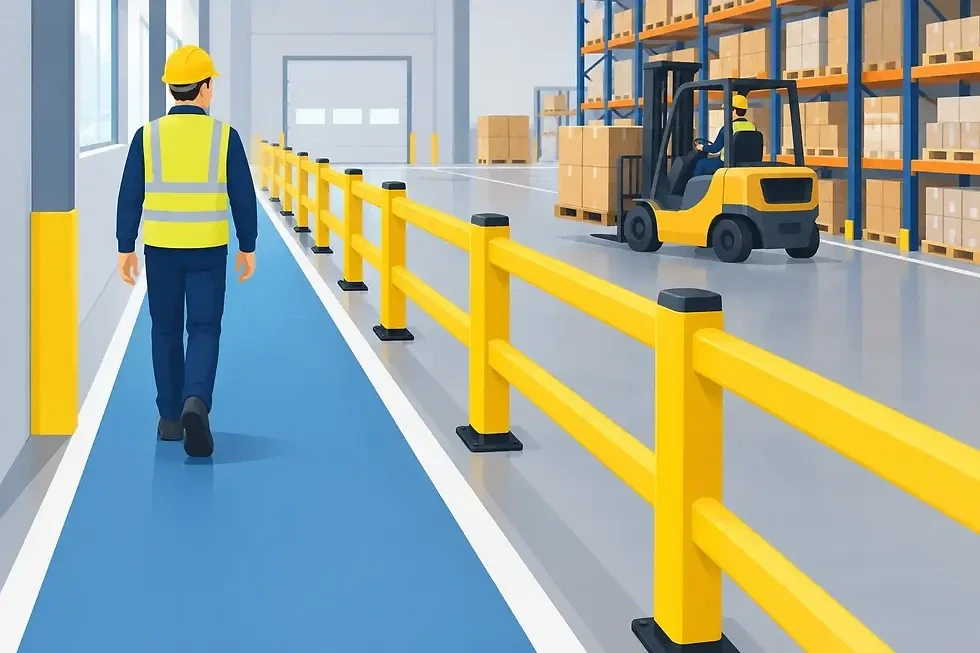
Guardrails, bollards, fencing, and similar barriers can create clear separation between pedestrian paths and vehicle lanes.

They can be particularly useful along:

Busy aisles, rack ends, packing stations, pedestrian work areas, and high-traffic intersections.

Physical separation is generally stronger than painted lines because it does not depend entirely on a worker or operator remaining inside the marked route.

Use Marked Walkways

Where barriers are not practical, clearly marked pedestrian walkways can establish predictable routes.

Walkways should connect the places employees actually need to reach.

A path that ends abruptly or forces employees to take a long detour may encourage shortcuts.

The route should be visible, maintained, and kept free from stored material.

Arbill’s warehouse, 3PL, and data center safety solutions can support facilities addressing PPE, vehicle interaction, material handling, training, and other warehouse safety challenges.

Create Controlled Pedestrian Crossings

Some interaction between forklifts and pedestrians may be unavoidable.

Where workers need to cross vehicle routes, establish defined crossings instead of allowing employees to cross wherever convenient.

Place crossings where visibility is good and turning movements are limited.

Avoid positioning them directly at blind corners whenever possible.

Mirrors, signs, lighting, floor markings, and physical controls can reinforce the crossing.

Workers should understand that designated crossings reduce unpredictability only when people actually use them.

Consider One-Way Forklift Routes

One-way traffic can simplify vehicle movement in busy warehouses.

Instead of operators approaching each other from both directions, traffic follows a more predictable pattern.

This can reduce congestion and make intersections easier for pedestrians to understand.

Before establishing a one-way route, confirm that forklifts can complete turns safely and that the new path does not create additional pedestrian conflicts.

The route must also remain usable when inventory levels increase.

A traffic plan that works only when the warehouse is half empty may fail during peak season.

Keep Pedestrian Routes Clear

A marked walkway provides little value when pallets, cartons, shrink wrap, carts, or equipment block it.

When the pedestrian route becomes obstructed, workers may step into the forklift lane to get around the problem.

Housekeeping is therefore part of traffic management.

Assign responsibility for removing:

Empty pallets, loose packaging, carts, cords, debris, and temporary stock from pedestrian routes.

Supervisors should also watch for staging practices that gradually narrow designated walkways.

Improve Lighting Around Traffic Areas

Employees and operators need enough light to see:

People, floor markings, signs, load conditions, rack edges, dock transitions, and approaching equipment.

Pay particular attention to rack aisles, dock areas, indoor-outdoor transitions, and locations where daylight changes throughout the shift.

A failed light at a blind intersection should be treated as a traffic safety issue rather than routine maintenance.

Use Mirrors, Signs, Horns, and Warning Devices

Several smaller controls can work together around difficult intersections.

Convex mirrors can improve visibility around rack ends.

Traffic signs can identify crossings, stop points, and speed restrictions.

Forklift horns can warn pedestrians where visibility is obstructed.

Warning lights and alarms may provide additional awareness.

However, these controls have limitations.

Mirrors can become blocked.

Signs may become background scenery.

Horns can be difficult to hear in noisy facilities.

That is why they should support—not replace—well-designed traffic separation.

Control Forklift Speed

Safe speed depends on more than a number posted on a wall.

Operators need to consider:

Congestion, visibility, surface conditions, load stability, pedestrian activity, aisle width, and stopping distance.

A speed that is reasonable in an open aisle may be inappropriate near a loading dock or blind crossing.

Operators should slow down before turns and obstructed intersections rather than waiting until they reach them.

Production expectations should never encourage operators to move faster than conditions allow.

Train Operators for the Specific Workplace

Forklift safety training needs to address both the equipment and the environment where it is used.

Operators should understand the characteristics of the truck they operate as well as workplace-specific hazards such as:

Pedestrian routes, ramps, dock edges, narrow aisles, visibility problems, surface conditions, and congested areas.

A worker who safely operates a forklift in an open yard may still need additional instruction before operating inside a high-density warehouse.

Training should also reinforce pedestrian right-of-way and safe behavior around blind areas.

”As long as people go to work, we have an opportunity to help protect them.

Julie Copeland
Arbill CEO

Julie Copeland Arbill CEO

Inspect Forklifts Before Operation

A vehicle with defective brakes, steering, warning devices, or other critical components can increase collision risk.

Forklifts should be examined before being placed into service, and unsafe trucks should be removed from operation until corrected.

Inspections should follow the equipment and employer’s established procedures.

Operators should understand that completing the inspection is not simply paperwork.

If a problem affects safe operation, it needs action before the truck enters the warehouse.

Maintain Stable Loads

A forklift carrying an unstable or poorly positioned load creates hazards for both operators and pedestrians.

Loads should remain within the truck’s rated capacity and be appropriately balanced and secured.

Operators also need adequate visibility.

If a load prevents safe forward visibility, the operator should use an approved travel method appropriate to the truck and workplace.

Pedestrians should never pass beneath elevated forks or loads.

Loading Docks Need Extra Attention

Loading docks combine several serious exposures within a limited area.

Forklifts enter trailers, trucks move into and away from docks, employees walk around freight, dockboards bridge elevation changes, and materials may accumulate near travel paths.

Treat dock traffic as a separate part of the forklift safety program.

Inspect:

Dockboards, trailer restraints, walking paths, lighting, edge protection, floor conditions, and pedestrian waiting areas.

Workers who do not need to participate in loading should remain outside active forklift routes.

Create Safe Waiting Areas

Drivers, warehouse employees, contractors, and visitors may need to remain near loading operations without being directly involved.

Provide designated waiting areas outside active vehicle lanes and rear-swing zones.

Where appropriate, physical barriers can add separation.

The waiting location should remain visible and accessible while keeping people away from turning forklifts and moving trailers.

Manage Shift Changes Carefully

Shift changes can create unusually high pedestrian volume.

Employees leaving the building may cross routes used by forklifts that are still operating.

Incoming workers may be focused on reaching their stations rather than watching equipment.

Facilities should evaluate whether certain forklift routes need temporary restrictions or additional supervision during these periods.

Staggered movement or dedicated pedestrian pathways can reduce interaction.

Seasonal Demand Can Change Traffic Patterns

A warehouse may operate safely most of the year and become significantly more congested during seasonal demand.

Additional inventory can block visibility.

Temporary workers may be unfamiliar with traffic rules.

Staging areas may expand into spaces normally kept clear.

More forklifts may operate simultaneously.

Safety reviews should therefore be repeated when operational volume changes significantly.

Arbill’s warehouse safety checklist for employers provides a broader framework for reviewing forklift operations, racking, docks, housekeeping, PPE, and other warehouse hazards.

Temporary Workers Need Site-Specific Instruction

Temporary and seasonal workers should understand forklift traffic rules before entering active warehouse areas.

They need to know:

Where pedestrian walkways are located, where they may cross, which zones are restricted, what warning devices mean, and how to report unsafe conditions.

A brief generic orientation may not be enough for a complex warehouse layout.

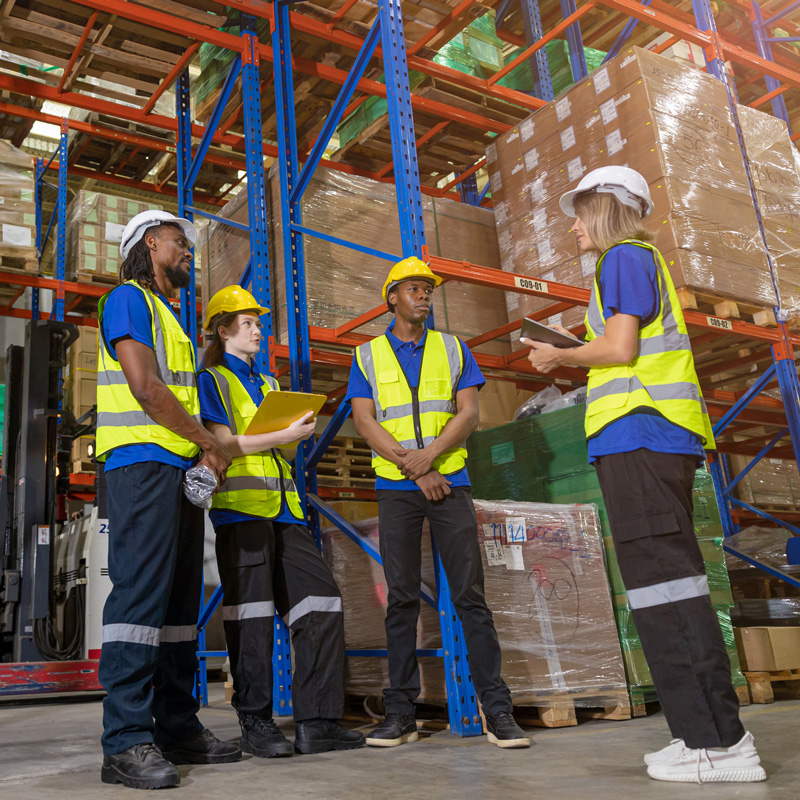
Site-specific instruction should show employees how to move safely through the actual facility.

High-Visibility Clothing Can Improve Conspicuity

Where employees work near mobile equipment, high-visibility apparel may improve the operator’s ability to recognize pedestrians.

Garment selection should reflect the work environment and applicable requirements.

The clothing should also remain visible as the outer layer.

If an employee puts an ordinary dark jacket over high-visibility apparel during cold weather, the benefit may be lost.

Arbill’s guide to high-visibility clothing and when it is required explains how visibility needs should be evaluated around traffic and workplace conditions.

High-visibility clothing supports pedestrian safety, but it does not replace barriers or traffic separation.

Add Forklift Proximity Detection Where Residual Risk Remains

Even after traffic routes are improved, some facilities still have locations where forklifts and pedestrians need to work close together.

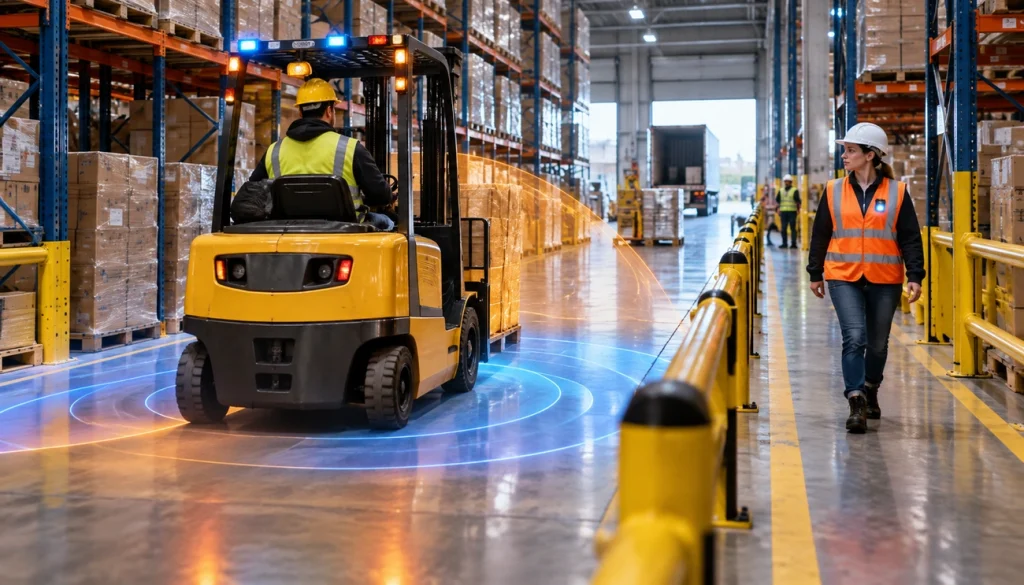
Proximity detection systems can add another layer of awareness.

A typical setup uses vehicle-mounted sensing equipment together with wearable devices or other detection technology.

When a pedestrian enters a defined proximity zone, the system can warn the pedestrian, operator, or both.

Depending on the design, alerts may involve:

Sound, lights, or vibration.

Proximity Alerts Can Help Around Blind Areas

The technology can be particularly valuable around:

Rack intersections, loading areas, changing staging zones, blind aisles, and locations where employees periodically enter forklift routes to scan or retrieve materials.

Instead of depending entirely on direct sight or hearing a horn, the worker receives an additional real-time warning.

Arbill’s TruSense™ Forklift is designed to provide this added layer of proximity awareness around powered equipment and pedestrians.

See Our Safety Services!
Forklift accidents and warehouse safety

Proximity Technology Does Not Replace Traffic Controls

Forklift proximity detection should not be used as justification for poorly designed pedestrian routes.

Technology should come after the facility has considered stronger controls.

The preferred sequence is to:

Separate traffic where practical, establish clear operating rules, train operators and pedestrians, improve sightlines, and then address remaining interaction with additional warning technology where useful.

Arbill’s guide on how forklift proximity detection systems help prevent workplace accidents explains how real-time proximity alerts can complement existing traffic controls.

Avoid Alarm Fatigue

Proximity systems need thoughtful setup.

If employees receive warnings constantly when no meaningful conflict exists, they may begin ignoring alerts.

Detection zones should therefore reflect the actual layout and speed of operations.

A pilot program can help determine whether:

The warning distance is appropriate, employees notice the alerts, busy periods create excessive alarms, or certain locations need different settings.

Worker feedback is particularly valuable during this process.

Review Forklift Near Misses

A collision does not need to occur before the traffic program is improved.

Near misses provide useful information.

Examples include:

A pedestrian stepping back from an approaching forklift, an operator braking suddenly, a worker entering a blind intersection at the same time as a truck, or a load narrowly missing nearby employees.

Record where the event occurred and what conditions contributed.

Several near misses at the same rack intersection should trigger a closer review even if nobody has been injured.

Look for Patterns Instead of Blaming Individuals

When a forklift-pedestrian near miss occurs, it may be tempting to conclude that either the operator or pedestrian “wasn’t paying attention.”

That may be part of the event, but the investigation should go deeper.

Ask whether:

Visibility was obstructed, the crossing was poorly located, speed was excessive, storage narrowed the route, lighting was inadequate, production pressure encouraged shortcuts, or pedestrian separation was insufficient.

Repeated unsafe interactions often reveal a system problem.

Use Proximity Events as a Leading Indicator

Forklift injuries are lagging indicators because they measure harm after it occurs.

Near misses and proximity events provide earlier information.

A growing number of high-risk interactions at one intersection can warn safety teams before a collision occurs.

Employers can monitor:

Near-miss location, repeated traffic conflicts, proximity alerts, corrective actions, and recurring sightline problems.

This information can help management decide where physical modifications or additional controls are needed.

Keep the Program Consistent Across Shifts

Warehouse conditions can vary significantly between shifts.

Night-shift lighting may be different.

Staffing levels may change.

One shift may have much heavier outbound freight.

Temporary employees may be concentrated during peak periods.

A traffic program should apply consistently while accounting for these differences.

Shift supervisors should communicate temporary conditions such as:

Blocked aisles, altered routes, maintenance activities, or overflow inventory.

One shift should not discover a major traffic change by accident.

Production Pressure Can Encourage Shortcuts

Warehouses often operate under demanding productivity targets.

During high-volume periods, employees may take shorter routes, operators may move more quickly, and staged freight may be placed wherever space is available.

These changes can undermine the traffic plan.

Safety expectations should remain realistic when production demand increases.

If workers routinely need to violate the designed traffic system to meet operational goals, the system or workflow needs review.

Prepare for Forklift Incidents

Even strong controls cannot eliminate every possible event.

Warehouses should have clear procedures for responding to:

Collisions, pedestrian injuries, tip-overs, property damage, and near misses.

Workers should know:

Who to notify, how to secure the area, how to summon first aid or emergency assistance, and how equipment should be preserved for investigation where appropriate.

The event should then feed back into the safety program.

A Practical Forklift-Pedestrian Safety Review

Warehouse managers should periodically review several basic questions.

Are pedestrian and forklift routes separated where practical?

Are crossings clearly defined?

Are blind intersections controlled?

Are aisles free from temporary storage?

Are forklift speeds appropriate for conditions?

Are operators trained and authorized?

Are trucks inspected before use?

Are loads stable?

Are dock operations controlled?

Do workers understand rear-swing hazards?

Are temporary workers trained on the traffic plan?

Are near misses being reported?

Would proximity technology add useful awareness in remaining high-risk areas?

A “no” answer identifies where the next improvement may be needed.

Conclusion

Forklift-pedestrian collisions are best prevented by reducing the opportunities for people and vehicles to occupy the same space.

That starts with understanding how traffic actually moves through the warehouse.

Map crossing points, identify blind areas, review dock activity, consider peak traffic periods, and look for routes that employees naturally use rather than relying only on the original floor plan.

Then create physical separation wherever practical.

Use barriers, dedicated walkways, controlled crossings, traffic signs, mirrors, lighting, horns, appropriate speeds, and clear operating procedures to make movement more predictable.

Operators need effective training and safe equipment, while pedestrians need site-specific instruction on how to move through active areas.

Where meaningful forklift-pedestrian interaction remains, proximity detection can add another layer of real-time awareness.

Most importantly, keep reviewing the system.

Warehouses change as inventory, staffing, staging, equipment, and production demands change. A traffic plan that worked six months ago may no longer match current operations.

Near misses, employee feedback, and proximity events can reveal those changes before a serious collision occurs.

When physical separation, trained workers, safe operating practices, and real-time awareness work together, busy warehouses can move products efficiently without treating pedestrian exposure as an unavoidable part of the job.

Request a Safety Assessment

Recent Posts

How Smart Sensors Are Changing Warehouse Operations
Forklift Safety Technology: How Smart Sensors Are Changing Warehouse Operations

Forklift Safety Technology: How Smart Sensors Are Changing Warehouse Operations

The Ultimate Warehouse Safety Guide for Busy Operations
Forklift Pedestrian Safety: How to Reduce Collisions in Busy Warehouses

Forklift Pedestrian Safety: How to Reduce Collisions in Busy Warehouses

How Forklift Proximity Detection Systems Help Prevent Workplace Accidents

How Forklift Proximity Detection Systems Help Prevent Workplace Accidents

Safety Training
Leading vs. Lagging Safety Indicators: What Should You Track?

Leading vs. Lagging Safety Indicators: What Should You Track?

How to Conduct a Job Hazard Analysis - Your Complete Risk Assessment
What Is a Job Hazard Analysis (JHA) and How Do You Conduct One?

What Is a Job Hazard Analysis (JHA) and How Do You Conduct One?

  • Previous ProjectForklift Safety Technology: How Smart Sensors Are Changing Warehouse Operations

  • Next ProjectHow Forklift Proximity Detection Systems Help Prevent Workplace Accidents

CUSTOMER SERVICE

800-523-5367

CONTACT US

Complete the short form below and an Arbill representative will get back to you within 24 hours.
* Required Fields

    ARBILL RESPECTS YOUR PRIVACY AND YOUR INFORMATION: By submitting the form above you agree to receiving emails from Arbill. Your submitted information is NEVER shared. You may unsubscribe at any time via the "unsubscribe" link in our emails. You can view our Privacy Policy HERE.