
Arc flash incidents can release intense thermal energy, pressure, molten metal, light, and flying debris in a fraction of a second.

For workers performing electrical troubleshooting, maintenance, testing, switching, or other tasks near energized equipment, the consequences can include severe burns, hearing damage, eye injuries, and other trauma.

That is why arc flash PPE selection cannot be based on guesswork.

Employers need to determine whether an arc flash hazard exists, evaluate the potential exposure, establish the arc flash boundary, and select protective clothing and equipment with an arc rating suitable for the hazard.

NFPA 70E provides the primary industry framework for making those decisions, while OSHA establishes the employer’s legal responsibility to protect workers from electrical hazards.

What Is an Arc Flash?

An arc flash occurs when electrical current travels through an unintended path through the air between energized conductors or between a conductor and ground.

The event can release intense heat and energy almost instantly.

Workers may be exposed not only to thermal burns but also to flying molten material, intense light, pressure, noise, and damaged electrical components.

Because an arc flash can develop extremely quickly, PPE is designed to reduce injury when other controls cannot completely eliminate the exposure.

OSHA vs. NFPA 70E

Employers sometimes assume that NFPA 70E and OSHA are interchangeable.

They are not.

OSHA Establishes Legal Requirements

OSHA 29 CFR 1910.335 requires employees working where electrical hazards exist to use protective equipment appropriate for the body parts being protected and the work being performed.

OSHA also specifically requires eye or face protection where workers could be injured by electric arcs, flashes, or flying objects produced by an electrical explosion.

Protective shields, barriers, or insulating materials may also be required where dangerous electrical heating or arcing could occur.

NFPA 70E Provides a Detailed Safety Framework

NFPA 70E provides detailed methods for electrical safety-related work practices, including arc flash risk assessment, boundaries, work practices, and PPE selection.

For employers, OSHA creates the legal duty while NFPA 70E provides a practical framework for addressing arc flash hazards.

De-Energization Comes Before PPE

Arc flash PPE should not be treated as the primary control.

Electrical equipment should generally be placed in an electrically safe work condition before employees perform work where exposure to energized parts can be avoided.

De-energization, lockout/tagout, and verification significantly reduce arc flash exposure.

PPE becomes especially important during justified energized work and during tasks such as testing for absence of voltage, when workers may still be exposed until the de-energized condition has been verified.

Explore Our Solutions!
Arc Flash PPE for Workplace Safety

How Arc Flash PPE Is Selected

NFPA 70E allows two primary approaches to arc flash PPE selection:

  • The incident energy analysis method
  • The arc flash PPE category method

These methods should not be mixed for the same task.

Incident Energy Analysis

An incident energy analysis calculates the expected thermal energy at a specific working distance, usually expressed in calories per square centimeter.

The PPE system then needs an arc rating at least equal to the calculated exposure.

For example, if a label identifies incident energy of 11 cal/cm² at the working distance, PPE rated only 8 cal/cm² would not provide sufficient arc rating for that exposure.

Arc Flash PPE Category Method

Where NFPA 70E tables apply and all listed parameters are satisfied, employers may use the category method.

The equipment type, available fault current, fault-clearing time, working distance, and task must fit within the table limitations.

If those conditions are unknown or outside the permitted parameters, an incident energy analysis may be necessary.

NFPA 70E Arc Flash PPE Categories

The four commonly referenced categories correspond to increasing minimum arc ratings:

Arc Flash PPE Category Minimum Arc Rating
Category 1 4 cal/cm²
Category 2 8 cal/cm²
Category 3 25 cal/cm²
Category 4 40 cal/cm²

A category is not simply a description of how dangerous equipment is. It is a PPE-selection result based on specific equipment, task, and system parameters.

Category 1 Arc Flash PPE

Category 1 requires a minimum arc rating of 4 cal/cm².

Typical protection may include arc-rated long-sleeve clothing or an arc-rated coverall together with appropriate face, head, eye, hearing, hand, and other protection required for the task.

The employer must still confirm that the PPE category method applies to the specific equipment and task.

Category 2 Arc Flash PPE

Category 2 requires a minimum arc rating of 8 cal/cm².

The clothing system commonly includes arc-rated garments providing at least the required system rating.

Head and face protection becomes more substantial and may include an arc-rated face shield with an arc-rated balaclava or an appropriate arc flash hood, depending on the applicable requirements.

Hard hats, safety eyewear, hearing protection, and suitable hand protection remain important parts of the complete PPE system.

Category 3 Arc Flash PPE

Category 3 requires a minimum system arc rating of 25 cal/cm².

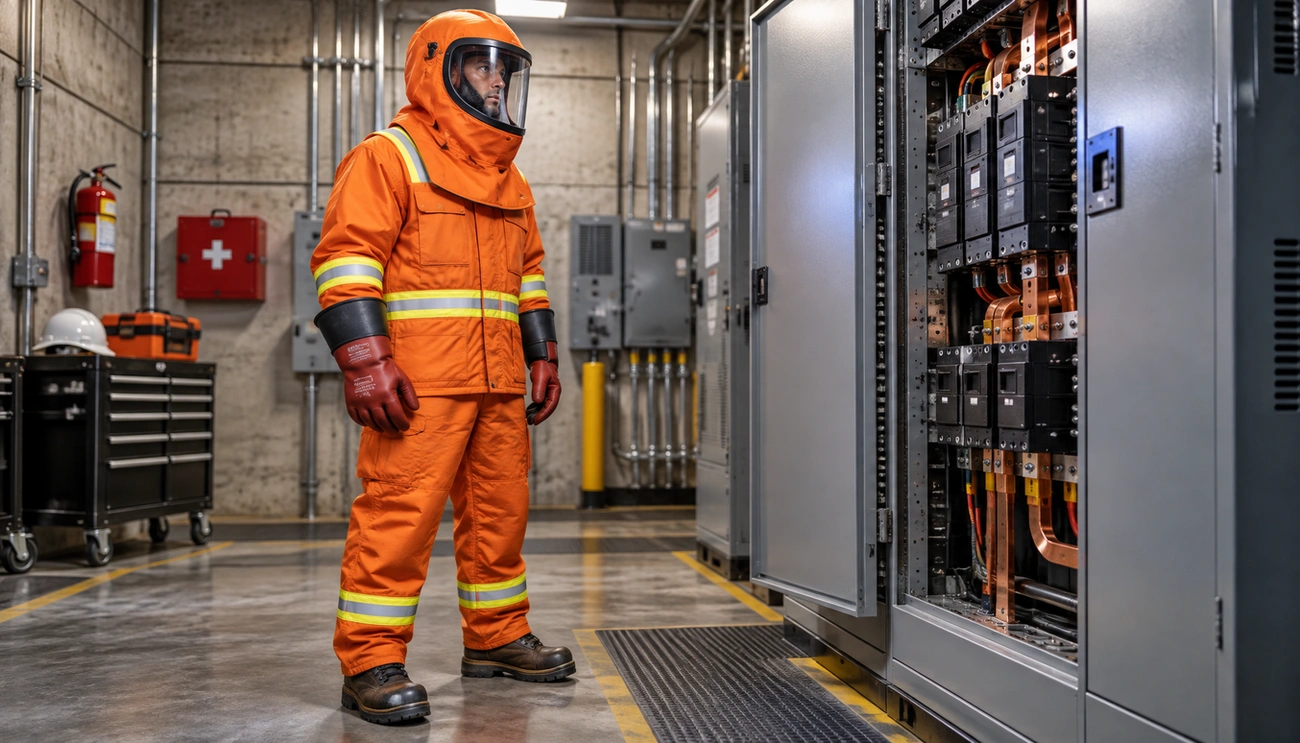
At this level, workers may require an arc flash suit system that includes arc-rated body protection and an arc-rated hood, together with applicable eye, hearing, hand, head, and footwear protection.

The entire clothing system needs to provide the necessary arc rating.

Category 4 Arc Flash PPE

Category 4 requires a minimum system arc rating of 40 cal/cm².

This level commonly requires a full arc flash suit system, including arc-rated suit components and hood, along with other required protective equipment.

Category 4 represents very high thermal exposure.

Selecting 40 cal/cm² PPE should never become a substitute for evaluating whether energized work can be avoided.

Arc-Rated Clothing vs. Flame-Resistant Clothing

Arc-rated and flame-resistant are related terms, but they are not interchangeable.

Arc-rated clothing has been evaluated for exposure to electric arc thermal energy and carries a specific arc rating.

A garment may be flame resistant without necessarily having the arc rating required for a particular electrical task.

For arc flash protection, employers should verify the garment’s actual arc rating rather than relying only on an FR designation.

Head and Face Protection

The head and face may be exposed to intense heat, molten material, and blast effects during an arc flash.

Arc-Rated Face Shields

For applicable lower-energy exposures, an arc-rated face shield may be part of the required PPE system.

The shield should provide suitable coverage and carry an arc rating appropriate for the exposure.

Arc Flash Suit Hoods

Higher-energy exposures generally require an arc-rated hood as part of the protective ensemble.

The hood should be compatible with the rest of the PPE and rated for the identified hazard.

”As long as people go to work, we have an opportunity to help protect them.

Julie Copeland
Arbill CEO

Julie Copeland Arbill CEO

Eye Protection

Arc flash face protection does not necessarily eliminate the need for primary eye protection.

Safety glasses or goggles may still be required beneath a face shield or hood.

The eyewear should fit properly without interfering with the other protective equipment.

Hearing Protection

Arc flash incidents can produce intense sound and pressure.

Hearing protection, commonly including ear canal inserts such as earplugs, may therefore be part of the arc flash PPE ensemble.

Employers should not focus only on thermal clothing when evaluating overall protection.

Hand Protection

Hands may face both shock and arc flash hazards.

Those hazards need to be evaluated separately.

Rubber Insulating Gloves

When shock protection is required, voltage-rated rubber insulating gloves may be necessary.

Leather protectors are often worn over rubber insulating gloves to protect the insulating material from physical damage.

Arc-Rated Gloves

Where arc flash rather than shock is the primary hand hazard, arc-rated gloves may be appropriate.

The correct glove depends on the electrical hazard assessment.

One glove type should never be assumed to control every electrical hazard.

Footwear

Footwear may also form part of the PPE system.

Employers should evaluate arc flash exposure separately from shock, impact, compression, puncture, slip, and other footwear hazards.

Selection should be based on the complete task.

Understand the Arc Flash Boundary

The arc flash boundary represents the distance at which a person could be exposed to a defined level of thermal incident energy.

Workers inside this boundary may require arc-rated PPE when an arc flash hazard exists.

The boundary is equipment- and condition-specific.

It should never be assumed to be the same distance for every panel or electrical system.

Arc Flash Labels Matter

Electrical equipment labels can provide important information to qualified workers.

Depending on the labeling approach, this may include:

  • System voltage
  • Arc flash boundary
  • Incident energy at a specified working distance
  • PPE-related information

The label is only useful when the underlying electrical-system data remains accurate.

Changes to equipment, protective devices, transformers, conductors, or system configuration may require the arc flash study and labels to be reviewed.

Do Not Select PPE by Voltage Alone

Voltage is only one factor in arc flash risk.

Incident energy can also be influenced by available fault current, protective-device clearing time, equipment configuration, working distance, and other system characteristics.

Two pieces of equipment operating at the same nominal voltage can create significantly different arc flash exposures.

PPE should therefore never be selected solely from the voltage printed on a panel.

Verification of an Electrically Safe Work Condition Still Carries Risk

Workers may assume that PPE is unnecessary because the equipment is expected to be de-energized.

However, until absence of voltage has actually been verified, an electrical hazard may still exist.

The PPE and work practices needed during verification should be determined before the test begins.

Inspect Arc Flash PPE Before Use

PPE can lose effectiveness because of damage, contamination, wear, or improper storage.

Workers should inspect garments, hoods, gloves, face shields, fasteners, closures, and other components before use.

Look for:

  • Tears or holes
  • Burn damage
  • Chemical or oil contamination
  • Damaged closures
  • Cracked shields
  • Worn or damaged gloves
  • Missing components

Damaged equipment should be removed from service according to manufacturer instructions and the employer’s electrical safety program.

Keep Arc-Rated Clothing Clean

Contamination can affect protective performance.

Oil, grease, chemicals, and other combustible materials may increase burn severity or compromise protective clothing.

Cleaning and laundering should follow manufacturer instructions.

Workers should not modify garments in ways that may reduce their protective performance.

Consider What Workers Wear Under Arc-Rated Clothing

Underlayers matter.

Materials that can melt when exposed to heat may contribute to injury during an arc flash.

The electrical safety program should specify suitable clothing beneath the arc-rated outer layer based on current NFPA 70E requirements and manufacturer recommendations.

Fit and Compatibility Matter

Arc flash PPE works as a system.

A hood should permit adequate visibility.

Gloves should allow safe tool control.

Safety eyewear must fit beneath the face protection.

Hard hats, hearing protection, and other items should not interfere with one another.

Workers should practice normal task movements while wearing the full PPE ensemble before beginning work.

Heat Stress and Arc Flash PPE

Arc-rated garments and flash suits can add significant heat burden.

That does not justify removing required PPE.

Employers should manage heat exposure through hydration, rest, cooling, workload planning, and other appropriate controls.

Electrical protection and heat-stress prevention should be managed together.

Qualified Worker Training

Arc flash PPE should be only one element of electrical safety training.

Qualified workers need to understand electrical hazards, shock and arc flash risk, boundaries, safe work practices, equipment condition, test instruments, PPE selection, PPE inspection, and emergency response.

Training should reflect the employee’s actual responsibilities and equipment.

PPE Categories Are Not a Shortcut Around Risk Assessment

It can be tempting to label equipment with a category and treat that number as the entire safety program.

That misses the purpose of NFPA 70E.

Employers should first determine whether an arc flash hazard exists and whether energized work is justified.

If the category method is used, all applicable table parameters must be satisfied.

If the equipment falls outside those limitations, simply selecting a higher category is not necessarily the correct solution.

An incident energy analysis may be required.

Common Arc Flash PPE Mistakes

One common mistake is wearing ordinary FR clothing without verifying the arc rating.

Another is selecting PPE solely by voltage.

Other weaknesses include using outdated labels, ignoring electrical-system modifications, wearing damaged or contaminated garments, selecting insufficiently rated equipment, mixing incompatible PPE, failing to verify isolation, or performing energized work when de-energization is feasible.

The strongest programs control the electrical hazard first and use PPE for the remaining exposure.

See Our Safety Services!
Arc Flash PPE for Utilities & Power Companies

Build Arc Flash PPE Into the Electrical Safety Program

PPE management should connect with the broader electrical safety system.

The organization should maintain processes for:

  • Electrical risk assessment
  • Energized-work justification
  • Equipment labeling
  • PPE selection
  • PPE inspection
  • Training
  • Electrically safe work condition procedures
  • Lockout/tagout
  • Electrical-system changes
  • Periodic program review

Arbill’s EHS safety services can help industrial organizations identify workplace safety and compliance gaps, strengthen employee training, and improve electrical safety practices.

Conclusion

Arc flash PPE is not simply a heavy suit worn for electrical work.

The correct protection depends on the actual arc flash hazard, task, equipment condition, working distance, system parameters, and the PPE-selection method being used.

NFPA 70E provides two primary selection approaches: incident energy analysis and the arc flash PPE category method.

Under the category approach, minimum arc ratings increase from 4 cal/cm² for Category 1 to 40 cal/cm² for Category 4.

However, PPE should remain the last line of defense.

Whenever feasible, de-energizing equipment, establishing an electrically safe work condition, and applying effective engineering and administrative controls provide stronger protection than relying on PPE alone.

When energized exposure remains, employers should select a complete PPE system that addresses the head, face, eyes, hearing, body, hands, and other exposed areas according to the assessed hazard.

That combination of hazard assessment, safe work practices, proper PPE, training, and verification creates a much stronger electrical safety program.

Request a Safety Assessment

Recent Posts

How Smart Sensors Are Changing Warehouse Operations
Forklift Safety Technology: How Smart Sensors Are Changing Warehouse Operations

Forklift Safety Technology: How Smart Sensors Are Changing Warehouse Operations

The Ultimate Warehouse Safety Guide for Busy Operations
Forklift Pedestrian Safety: How to Reduce Collisions in Busy Warehouses

Forklift Pedestrian Safety: How to Reduce Collisions in Busy Warehouses

How Forklift Proximity Detection Systems Help Prevent Workplace Accidents

How Forklift Proximity Detection Systems Help Prevent Workplace Accidents

Safety Training
Leading vs. Lagging Safety Indicators: What Should You Track?

Leading vs. Lagging Safety Indicators: What Should You Track?

How to Conduct a Job Hazard Analysis - Your Complete Risk Assessment
What Is a Job Hazard Analysis (JHA) and How Do You Conduct One?

What Is a Job Hazard Analysis (JHA) and How Do You Conduct One?

  • Previous ProjectWhat Is High-Visibility Clothing and When Is It Required?

  • Next ProjectHow to Improve Safety Culture in Industrial Workplaces

CUSTOMER SERVICE

800-523-5367

CONTACT US

Complete the short form below and an Arbill representative will get back to you within 24 hours.
* Required Fields

    ARBILL RESPECTS YOUR PRIVACY AND YOUR INFORMATION: By submitting the form above you agree to receiving emails from Arbill. Your submitted information is NEVER shared. You may unsubscribe at any time via the "unsubscribe" link in our emails. You can view our Privacy Policy HERE.