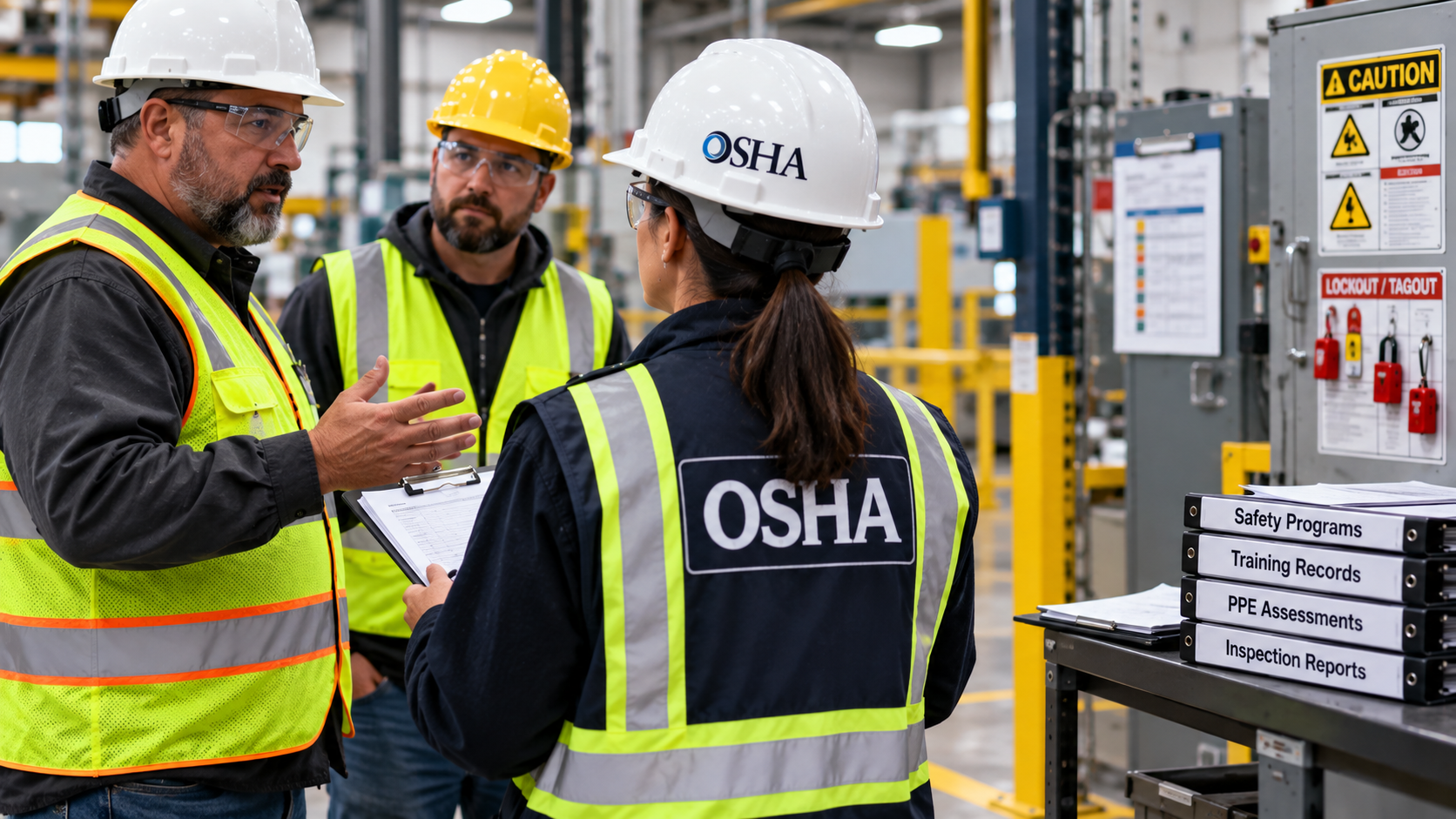
An OSHA inspection can happen with little or no advance notice, which means employers should not wait until a compliance officer arrives to start thinking about workplace safety.
The strongest preparation happens long before an inspection. Written programs should reflect actual workplace practices, training records should be current, required logs should be organized, hazards should be corrected when identified, and employees should understand the safety procedures that apply to their jobs. When those fundamentals are maintained consistently, an OSHA visit becomes less about scrambling for documents and more about demonstrating how the organization manages workplace safety every day.
Preparing properly also helps employers identify weaknesses before they become injuries, citations, or operational disruptions. The goal should not be to make a workplace temporarily look compliant for an inspector. It should be to build systems that remain effective whether OSHA is present or not.
Understand Why OSHA May Inspect a Workplace
OSHA does not inspect every facility on a fixed schedule. Inspections may result from several circumstances, including imminent-danger situations, serious injuries or fatalities, employee complaints or referrals, targeted enforcement programs, and follow-up activity.
Some facilities may also be selected as part of OSHA programs focused on particular industries or hazards. That means an employer with no recent serious incident can still receive an inspection.
Understanding this is important because there is rarely a single event employers can monitor as a warning. Maintaining inspection readiness throughout the year is more effective than trying to predict when OSHA will arrive.
Know What Happens During an OSHA Inspection
An OSHA inspection generally follows several stages. Knowing what to expect can help management respond calmly and professionally rather than making rushed decisions at the door.
Credential Presentation and Opening Conference
When a Compliance Safety and Health Officer arrives, the officer will identify themselves and explain the purpose and general scope of the inspection.
During the opening conference, OSHA may discuss why the inspection is occurring, which areas may be reviewed, what records may be requested, and who will participate in the inspection.
OSHA’s Field Operations Manual also explains that inspections may involve review of injury and illness records, workplace conditions, employee interviews, photographs, measurements, sampling, and other investigative methods. Employers can review the official OSHA Field Operations Manual for additional detail about the inspection process.
The Walkaround
After the opening conference, the compliance officer may inspect relevant areas of the workplace.
The officer may observe work practices, machinery, PPE, chemical handling, housekeeping, emergency equipment, fall protection, electrical systems, and other conditions related to the inspection.
The scope depends on the reason for the visit. A focused complaint inspection may begin with a particular hazard, while another inspection may involve a broader review.
During the walkaround, employers should cooperate while also keeping their own accurate record of what OSHA observes.
Employee Interviews
Compliance officers may speak with employees during the inspection, and OSHA has authority to conduct private employee interviews.
Employers should never coach workers to provide false or misleading information, discourage participation, or retaliate against employees for exercising their OSHA rights.
Strong preparation instead means employees already understand the company’s procedures because they have received effective training and use those procedures routinely.
Closing Conference
At the end of the inspection, the compliance officer generally conducts a closing conference.
Apparent violations or concerns may be discussed, along with potential corrective actions. However, the closing conference is not necessarily the final determination of whether citations will be issued.
Employers should listen carefully, take notes, clarify factual misunderstandings where appropriate, and begin correcting legitimate hazards promptly.
Conduct a Safety Assessment Before OSHA Does
One of the best preparation methods is to inspect the workplace from the perspective of an outside compliance professional.
Walk through production areas, warehouses, maintenance rooms, loading docks, offices, laboratories, outdoor operations, and other work areas. Look beyond obvious problems and evaluate whether written procedures match what employees actually do.
An assessment should examine physical hazards as well as program-level weaknesses. A machine may have all required guards while its lockout/tagout procedure is outdated. Employees may be wearing safety glasses, but the organization may lack a documented PPE hazard assessment. A first aid cabinet may be fully stocked while an emergency eyewash station is blocked by stored materials.
Arbill’s EHS safety assessments can help organizations identify gaps involving workplace hazards, written programs, training, PPE, and broader compliance practices before they become more serious problems.
Review Written Safety Programs
Written programs are often an important part of OSHA compliance.
Depending on the workplace and hazards, an employer may need programs covering areas such as hazard communication, respiratory protection, lockout/tagout, hearing conservation, PPE, confined spaces, emergency response, bloodborne pathogens, or other regulated activities.
Simply possessing a document is not enough.
The program should reflect the current workplace.
If equipment has changed, chemicals have been added, responsibilities have moved to different employees, or work procedures have been revised, the written program may also need updating.
Compare the Written Program With Actual Practice
This is where many compliance gaps become visible.
If a written lockout/tagout procedure says employees isolate three energy sources but technicians actually isolate five, the procedure may no longer reflect the equipment.
If the respiratory protection program lists respirators that are no longer used, the document may need revision.
If the hazard communication program identifies one person as responsible for Safety Data Sheets but that employee left the company two years ago, responsibilities should be updated.
Written programs should describe the workplace that exists today, not the workplace that existed when the document was originally created.
Organize OSHA Recordkeeping Documents
Employers covered by OSHA recordkeeping requirements should make sure applicable injury and illness records are complete, accurate, and accessible.
Depending on the employer, this may include OSHA Forms 300, 300A, and 301.
Records should be reviewed before an inspection reveals missing information, inconsistent classifications, or incomplete entries.
Do not alter records simply to make statistics appear better. Corrections should be based on accurate information and documented appropriately.
Facilities should also make sure the person responsible for OSHA recordkeeping understands the requirements rather than relying on a spreadsheet that no one has reviewed recently.