An OSHA inspection can happen with little or no advance notice, which means employers should not wait until a compliance officer arrives to start thinking about workplace safety.

The strongest preparation happens long before an inspection. Written programs should reflect actual workplace practices, training records should be current, required logs should be organized, hazards should be corrected when identified, and employees should understand the safety procedures that apply to their jobs. When those fundamentals are maintained consistently, an OSHA visit becomes less about scrambling for documents and more about demonstrating how the organization manages workplace safety every day.

Preparing properly also helps employers identify weaknesses before they become injuries, citations, or operational disruptions. The goal should not be to make a workplace temporarily look compliant for an inspector. It should be to build systems that remain effective whether OSHA is present or not.

Understand Why OSHA May Inspect a Workplace

OSHA does not inspect every facility on a fixed schedule. Inspections may result from several circumstances, including imminent-danger situations, serious injuries or fatalities, employee complaints or referrals, targeted enforcement programs, and follow-up activity.

Some facilities may also be selected as part of OSHA programs focused on particular industries or hazards. That means an employer with no recent serious incident can still receive an inspection.

Understanding this is important because there is rarely a single event employers can monitor as a warning. Maintaining inspection readiness throughout the year is more effective than trying to predict when OSHA will arrive.

Know What Happens During an OSHA Inspection

An OSHA inspection generally follows several stages. Knowing what to expect can help management respond calmly and professionally rather than making rushed decisions at the door.

Credential Presentation and Opening Conference

When a Compliance Safety and Health Officer arrives, the officer will identify themselves and explain the purpose and general scope of the inspection.

During the opening conference, OSHA may discuss why the inspection is occurring, which areas may be reviewed, what records may be requested, and who will participate in the inspection.

OSHA’s Field Operations Manual also explains that inspections may involve review of injury and illness records, workplace conditions, employee interviews, photographs, measurements, sampling, and other investigative methods. Employers can review the official OSHA Field Operations Manual for additional detail about the inspection process.

The Walkaround

After the opening conference, the compliance officer may inspect relevant areas of the workplace.

The officer may observe work practices, machinery, PPE, chemical handling, housekeeping, emergency equipment, fall protection, electrical systems, and other conditions related to the inspection.

The scope depends on the reason for the visit. A focused complaint inspection may begin with a particular hazard, while another inspection may involve a broader review.

During the walkaround, employers should cooperate while also keeping their own accurate record of what OSHA observes.

Employee Interviews

Compliance officers may speak with employees during the inspection, and OSHA has authority to conduct private employee interviews.

Employers should never coach workers to provide false or misleading information, discourage participation, or retaliate against employees for exercising their OSHA rights.

Strong preparation instead means employees already understand the company’s procedures because they have received effective training and use those procedures routinely.

Closing Conference

At the end of the inspection, the compliance officer generally conducts a closing conference.

Apparent violations or concerns may be discussed, along with potential corrective actions. However, the closing conference is not necessarily the final determination of whether citations will be issued.

Employers should listen carefully, take notes, clarify factual misunderstandings where appropriate, and begin correcting legitimate hazards promptly.

Conduct a Safety Assessment Before OSHA Does

One of the best preparation methods is to inspect the workplace from the perspective of an outside compliance professional.

Walk through production areas, warehouses, maintenance rooms, loading docks, offices, laboratories, outdoor operations, and other work areas. Look beyond obvious problems and evaluate whether written procedures match what employees actually do.

An assessment should examine physical hazards as well as program-level weaknesses. A machine may have all required guards while its lockout/tagout procedure is outdated. Employees may be wearing safety glasses, but the organization may lack a documented PPE hazard assessment. A first aid cabinet may be fully stocked while an emergency eyewash station is blocked by stored materials.

Arbill’s EHS safety assessments can help organizations identify gaps involving workplace hazards, written programs, training, PPE, and broader compliance practices before they become more serious problems.

Review Written Safety Programs

Written programs are often an important part of OSHA compliance.

Depending on the workplace and hazards, an employer may need programs covering areas such as hazard communication, respiratory protection, lockout/tagout, hearing conservation, PPE, confined spaces, emergency response, bloodborne pathogens, or other regulated activities.

Simply possessing a document is not enough.

The program should reflect the current workplace.

If equipment has changed, chemicals have been added, responsibilities have moved to different employees, or work procedures have been revised, the written program may also need updating.

Compare the Written Program With Actual Practice

This is where many compliance gaps become visible.

If a written lockout/tagout procedure says employees isolate three energy sources but technicians actually isolate five, the procedure may no longer reflect the equipment.

If the respiratory protection program lists respirators that are no longer used, the document may need revision.

If the hazard communication program identifies one person as responsible for Safety Data Sheets but that employee left the company two years ago, responsibilities should be updated.

Written programs should describe the workplace that exists today, not the workplace that existed when the document was originally created.

Organize OSHA Recordkeeping Documents

Employers covered by OSHA recordkeeping requirements should make sure applicable injury and illness records are complete, accurate, and accessible.

Depending on the employer, this may include OSHA Forms 300, 300A, and 301.

Records should be reviewed before an inspection reveals missing information, inconsistent classifications, or incomplete entries.

Do not alter records simply to make statistics appear better. Corrections should be based on accurate information and documented appropriately.

Facilities should also make sure the person responsible for OSHA recordkeeping understands the requirements rather than relying on a spreadsheet that no one has reviewed recently.

Explore Our Solutions!
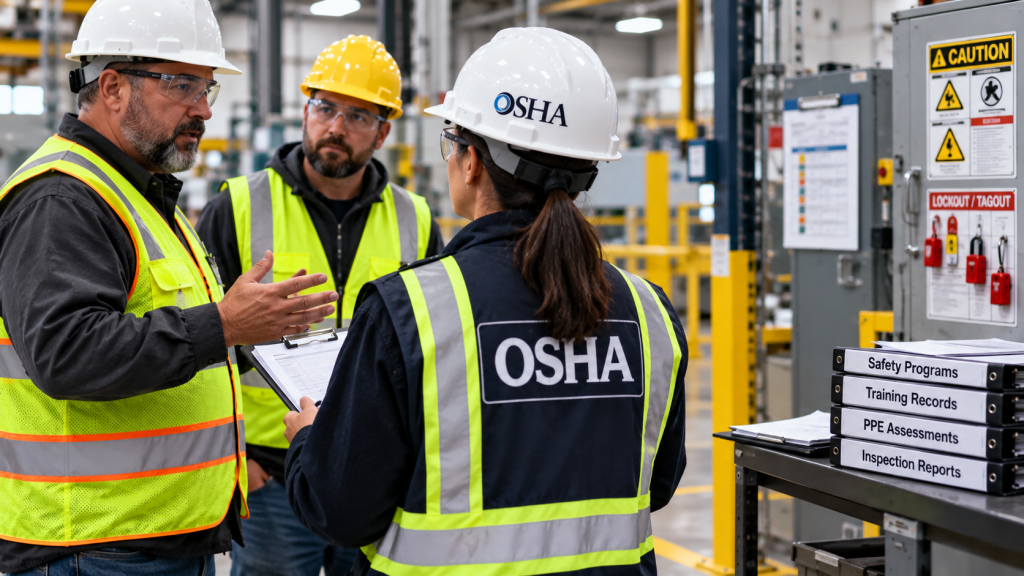
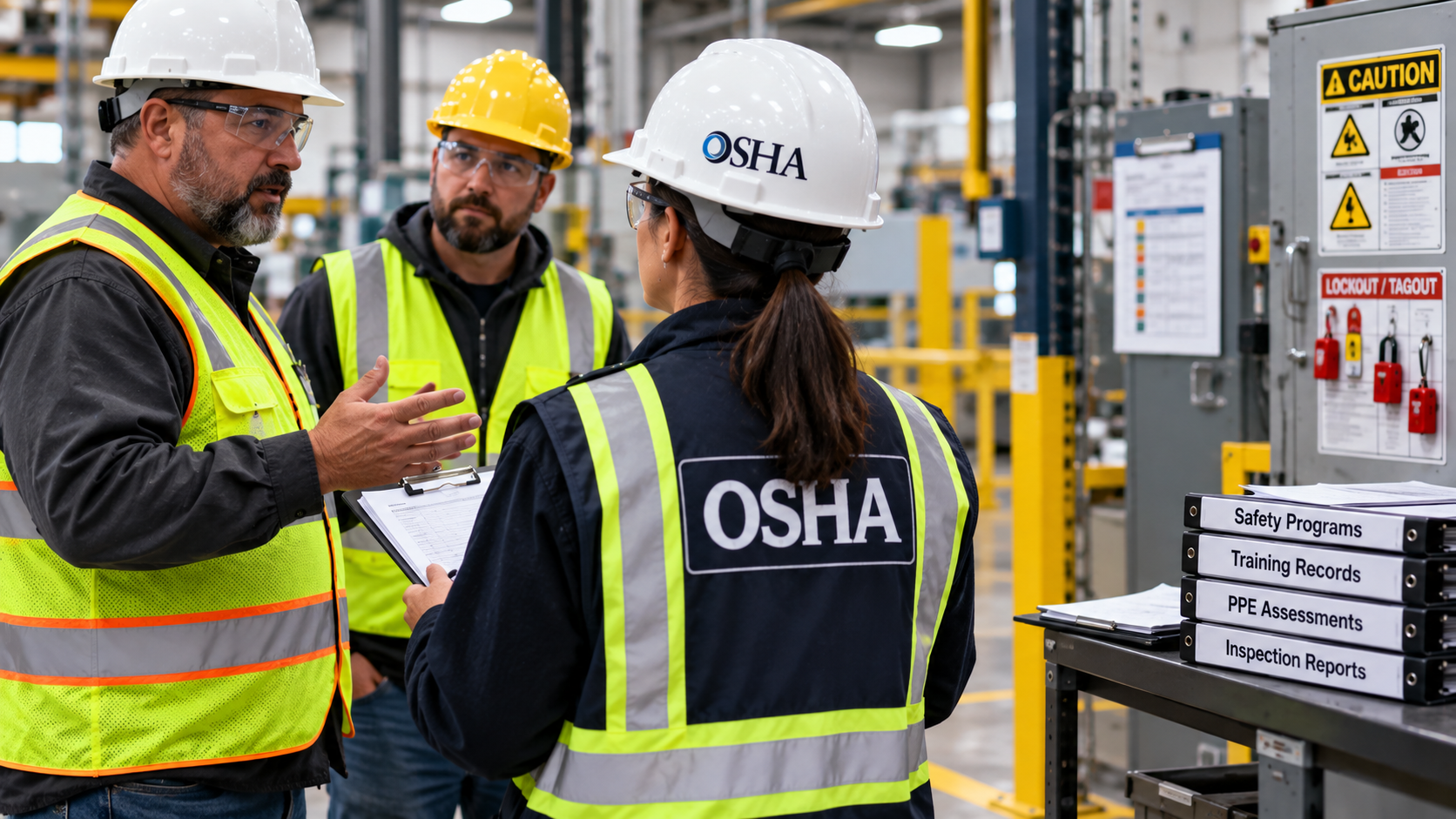
OSHA safety inspection with an inspector reviewing workplace conditions, safety records, lockout:tagout procedures, and employee compliance in an industrial facility

Review Training Records

Training records are another area that deserves attention before an OSHA inspection.

Employers should be able to demonstrate that required employees received applicable training and that training was provided at the appropriate time.

Records may include the employee’s name, training topic, completion date, instructor, certification, or other information required by the applicable standard or company procedure.

Verify the Training Was Actually Effective

A signature sheet proves attendance. It does not necessarily prove understanding.

During an inspection, an employee who cannot explain the procedure they supposedly learned may raise questions about the effectiveness of the training program.

Employees should understand the hazards they encounter, required PPE, emergency procedures, equipment rules, and safe work practices relevant to their jobs.

Arbill’s EHS safety training can support employers that need structured training around OSHA compliance and workplace hazards.

Check Your PPE Program

PPE is highly visible during a workplace inspection.

Inspectors may notice immediately when workers are missing eye protection, using damaged gloves, wearing inappropriate respiratory protection, or working at height without required fall protection.

However, preparation should go beyond asking whether employees are wearing equipment.

Employers should review whether PPE was selected from a proper hazard assessment, whether employees were trained, whether different sizes or models are available where needed, and whether equipment is inspected and replaced appropriately.

Arbill’s guide on how to perform a PPE hazard assessment explains how employers can connect PPE selection to actual task-based exposures.

Walk the Facility for Housekeeping Problems

Some of the easiest hazards to identify during an inspection are also among the easiest to correct beforehand.

Blocked exits, cluttered aisles, extension cords across walkways, leaking equipment, damaged stairs, overflowing waste, and improperly stored materials can create immediate concerns.

Good housekeeping should be an operating expectation rather than an activity performed only before visitors arrive.

If employees are accustomed to working around obvious hazards every day, those conditions have probably become normalized.

A fresh safety assessment can help identify what workers no longer notice.

Inspect Machine Guarding

Machine guarding frequently appears among OSHA’s commonly cited areas.

Employers should inspect machinery for missing, damaged, bypassed, or improperly positioned guards.

Pay particular attention to machines where guards are routinely removed for setup, cleaning, or adjustment.

If operators believe a guard makes the job difficult, they may develop informal workarounds.

Those workarounds should be investigated instead of ignored.

Supervisors should also know what to do when a machine guard is found missing or damaged. The equipment should not continue operating simply because production is busy.

Review Lockout/Tagout Procedures

Hazardous energy control is another area where paperwork and actual practice must match.

Review machine-specific energy-control procedures and verify that employees know how to apply them.

Periodic inspections should be completed where required, and retraining should occur when workplace changes or deficiencies trigger that need.

Do not focus only on electrical energy.

Machinery may also contain hydraulic, pneumatic, mechanical, gravitational, thermal, or stored energy.

Arbill’s lockout/tagout best practices for manufacturing facilities provides additional guidance for strengthening energy-control practices.

Check Hazard Communication

Employers using hazardous chemicals should make sure containers are appropriately labeled and Safety Data Sheets are accessible.

Secondary containers deserve particular attention because labels may be forgotten when chemicals are transferred from the original container.

Employees should also understand the hazards of the chemicals they use and know where to obtain SDS information.

During an inspection, a well-organized SDS system is much more useful than a large binder filled with outdated documents that employees do not know how to access.

Inspect Emergency Exits and Equipment

Emergency equipment should be easy to find and use.

Walk through the facility and check emergency exits, fire extinguishers, first aid supplies, eyewash stations, safety showers, alarms, and evacuation routes.

Look for blocked access.

Warehouse inventory, pallets, equipment, or temporary projects can gradually encroach on safety equipment.

A station that technically exists but cannot be reached quickly may not provide meaningful protection.

Review Fall Protection

Employers should identify locations where employees work near unprotected edges, floor openings, platforms, mezzanines, roofs, ladders, or other elevated surfaces.

Determine whether appropriate fall protection is available and being used correctly.

Also inspect the equipment itself.

Harnesses, lanyards, connectors, anchors, guardrails, and other components should be maintained according to applicable requirements and manufacturer instructions.

Temporary elevated work often deserves extra attention because protection may be less consistent than in permanent work areas.

”As long as people go to work, we have an opportunity to help protect them.

Julie Copeland
Arbill CEO

Julie Copeland Arbill CEO

Check Electrical Safety

Electrical hazards can be easy to overlook because many problems develop gradually.

Inspect extension cords, electrical panels, temporary wiring, damaged plugs, open knockouts, flexible cords, and access around electrical equipment.

Employees should not use damaged electrical equipment because replacement is inconvenient.

Electrical panels should also remain accessible rather than becoming storage areas.

If qualified employees perform energized electrical work, the facility should review its electrical safety practices, training, and PPE separately from basic facility electrical housekeeping.

Review Respiratory Protection

If employees are required to wear respirators, inspect the complete respiratory protection program.

Verify that respirators are appropriate for the hazard, employees have received required medical evaluations and fit testing, equipment is stored correctly, and cartridges or filters are managed according to the program.

Facial hair that interferes with a tight-fitting respirator seal can also create compliance problems.

Respiratory protection should never be treated as simply purchasing masks and handing them to employees.

Look at High-Injury and High-Risk Tasks

Incident history can help identify where an inspector may find broader weaknesses.

Review previous injuries, near misses, property damage, employee complaints, and recurring maintenance problems.

If several employees have experienced similar hand injuries, investigate the process.

If forklifts repeatedly strike the same rack, examine aisle layout and operating practices.

If workers repeatedly report eye irritation, determine whether ventilation, process controls, PPE, or chemical procedures need improvement.

Patterns often point toward systemic problems that deserve attention before they become more serious.

Prepare the Management Team

Employers should decide in advance who will respond if OSHA arrives.

The receptionist, security employee, or front-desk staff should know whom to contact rather than attempting to handle the inspection independently.

The designated management representative should understand the facility, safety programs, and inspection process.

A backup representative should also be identified.

Depending on the situation, employers may involve safety personnel, operations management, human resources, legal counsel, or other appropriate professionals.

Decide Who Will Accompany the Inspector

The employer may designate a representative to accompany the compliance officer during the walkaround.

Choose someone who understands both the workplace and the company’s safety practices.

The representative should remain professional, answer questions accurately, and avoid guessing when information is not known.

If OSHA photographs a condition, the employer may also choose to document the same condition for its own records where lawful and appropriate.

Maintaining accurate notes about areas visited, documents requested, samples taken, and concerns raised can be useful after the inspection.

Do Not Hide or Alter Conditions

Trying to quickly conceal hazards after OSHA arrives can create additional problems.

The better approach is to maintain the facility in an inspection-ready condition every day.

If a legitimate hazard is identified during the visit and it can be corrected immediately, correcting it demonstrates responsiveness. Employers should still document what was found and what corrective action was taken.

Never falsify records, alter documents, coach employees to provide inaccurate answers, or create backdated training records.

Prepare Employees Without Coaching Them

Employees do not need scripts for OSHA interviews.

They need effective training and accurate knowledge of their jobs.

Before an inspection ever occurs, workers should know how to explain the safety procedures they actually use.

An employee should be able to identify required PPE, describe emergency actions, understand hazard reporting, and explain basic safe-work procedures relevant to their role.

Training employees honestly throughout the year is much more effective than attempting to prepare answers after an inspector arrives.

Correct Known Hazards Before the Inspection

Internal inspection findings should lead to corrective action.

Do not repeatedly document the same missing guard, blocked aisle, damaged ladder, expired training, or leaking machine without resolving it.

Create a system that assigns responsibility and tracks completion.

Higher-risk hazards should receive priority, particularly when they could result in serious injury.

For larger or more complex compliance gaps, organizations may benefit from outside assistance. Arbill’s EHS safety consulting can support employers with program development, compliance reviews, corrective-action planning, and broader EHS needs.

Review Previous OSHA Citations and Corrective Actions

If the facility has been inspected before, review previous citations and ensure corrective measures remain effective.

A hazard that was corrected temporarily but later returned can create additional concern.

Follow-up reviews should confirm that the underlying cause was addressed.

This is also useful for locations within the same company. If another facility was cited for a condition that could exist at your site, use that information proactively.

Conduct a Mock OSHA Inspection

A mock inspection can reveal weaknesses that routine supervisors may overlook.

Approach the workplace as though you have never seen it before.

Start at the front entrance and follow the same types of areas an outside visitor may observe.

Review selected records, walk through work areas, speak with employees, and document findings.

Avoid making the exercise unrealistically easy. If internal inspectors already know where every strong program exists, they may unconsciously avoid areas that need improvement.

An independent safety professional can sometimes provide a more objective view.

Keep Documentation Organized

Compliance records should be retrievable without searching through multiple desks, email accounts, or disconnected file systems.

Organizations may maintain digital, paper, or mixed systems depending on their needs, but responsibilities should be clear.

Common records may include safety programs, training documentation, hazard assessments, equipment inspections, injury and illness records, exposure monitoring, fit testing, medical-program documentation where applicable, and corrective-action records.

Not every document must be handed over automatically. Employers should understand what OSHA has requested and provide appropriate records through the designated company representative.

During the Inspection, Stay Professional

An OSHA inspection can create stress, particularly for supervisors who have never experienced one.

A calm, organized response is usually more productive than becoming defensive.

Listen carefully to questions.

Provide accurate information.

If the answer is not known, say that you need to verify it rather than guessing.

Keep track of requested documents and observations.

If the inspector identifies a condition that can be corrected immediately, address it appropriately without interfering with the inspection.

Professional cooperation and careful documentation can help everyone understand the facts.

After the Walkaround, Act Quickly

Do not wait for a formal citation before addressing hazards identified during the inspection.

If the compliance officer points out a damaged guard, blocked exit, chemical-labeling problem, or other legitimate concern, begin evaluating and correcting it.

Document corrective actions with dates, photographs, work orders, training records, or other appropriate evidence.

Prompt action protects workers regardless of what happens later in the enforcement process.

Prepare for the Closing Conference

The closing conference gives the employer an opportunity to hear the compliance officer’s preliminary observations.

Take detailed notes.

Ask for clarification when necessary.

If the inspector’s understanding of a process is incomplete, provide factual information that helps explain the condition.

Avoid arguing simply for the sake of disagreement.

The objective is to make sure OSHA has accurate information and that the employer understands the concerns that were identified.

See Our Safety Services!
OSHA Standards

Treat Inspection Readiness as an Ongoing Process

The best time to prepare for an OSHA inspection is not the morning an inspector arrives.

Inspection readiness should be built into everyday safety management.

Review programs when operations change. Train employees before they perform hazardous work. Inspect equipment routinely. Correct hazards when workers report them. Keep records current rather than reconstructing them months later.

Employers that follow these practices are not merely preparing for OSHA.

They are reducing the conditions that lead to injuries, downtime, and regulatory problems in the first place.

OSHA Inspection Preparation Checklist

Before an inspection occurs, employers should confirm that the fundamentals are in place:

  • Written safety programs are current and reflect actual operations.
  • Required OSHA records and training documents are organized.
  • PPE hazard assessments have been completed where required.
  • Machine guards and energy-control procedures are maintained.
  • Hazard communication information and SDSs are accessible.
  • Emergency exits and safety equipment remain unobstructed.
  • Fall, electrical, respiratory, and chemical hazards have been reviewed.
  • Employees understand the procedures that apply to their work.
  • Previous inspection findings and internal audit issues have been corrected.
  • Management knows who will respond if OSHA arrives.

The checklist should be adapted to the hazards and regulatory requirements of each facility rather than treated as a universal compliance form.

Conclusion

Preparing for an OSHA safety inspection is ultimately about maintaining a workplace that can withstand careful examination on any normal working day.

Employers should know their hazards, maintain accurate safety programs and records, train employees effectively, inspect the workplace regularly, and correct problems when they are identified. Management should also understand the inspection process so the organization can respond calmly and professionally when a compliance officer arrives.

Mock inspections, periodic EHS assessments, employee feedback, and review of incidents and near misses can reveal problems before they become citations or injuries.

The strongest inspection strategy is therefore not a last-minute cleanup. It is a safety management system that works consistently throughout the year.

Request a Safety Assessment

Recent Posts

OSHA safety inspection with an inspector reviewing workplace conditions, safety records, lockout:tagout procedures, and employee compliance in an industrial facility
How to Prepare for an OSHA Safety Inspection

How to Prepare for an OSHA Safety Inspection

Warehouse safety inspection with a supervisor reviewing a checklist near forklifts, storage racks, marked walkways, and workers in high-visibility PPE
Warehouse Safety Checklist for Employers

Warehouse Safety Checklist for Employers

Flame Resistant Clothing
Everything You Need to Know About FR (Flame-Resistant) Clothing

Everything You Need to Know About FR (Flame-Resistant) Clothing

Lockout Tagout Electrical Consulting
Workplace Slips, Trips, and Falls: Prevention Strategies That Work

Workplace Slips, Trips, and Falls: Prevention Strategies That Work

Winter job site safety with workers in high-visibility clothing walking through snow and ice near heavy construction equipment
How Winter Weather Impacts Job Site Safety

How Winter Weather Impacts Job Site Safety

  • Next ProjectWarehouse Safety Checklist for Employers

CUSTOMER SERVICE

800-523-5367

CONTACT US

Complete the short form below and an Arbill representative will get back to you within 24 hours.
* Required Fields

    ARBILL RESPECTS YOUR PRIVACY AND YOUR INFORMATION: By submitting the form above you agree to receiving emails from Arbill. Your submitted information is NEVER shared. You may unsubscribe at any time via the "unsubscribe" link in our emails. You can view our Privacy Policy HERE.